


What Microphones Do You Actually Need for a Live Event? A Practical Audio Guide
Professional live event audio is about more than microphones. The right sound comes from matching the microphone setup to the venue, performers, and event format, then managing the entire system with expert engineering, monitoring, and real-time audio control.
Choosing the right microphones for a live event depends on the format, the performers, and the environment. But microphones alone do not guarantee good sound. Professional audio at a live event comes from how every component in the system is selected, configured, and managed in real time by an experienced engineer. This guide covers every microphone type used in live event production, the system decisions that determine whether the sound is consistent and clear, and the field insights from Portland Production Services on what actually goes wrong when these decisions are made without professional expertise.
Microphones Are Tools, Not Solutions
There is no single best microphone for live events. Any claim to the contrary is a simplification that will eventually produce a bad result in the wrong environment.
Every microphone is designed for a specific acoustic purpose: a specific directional pickup pattern, a specific frequency response, a specific ability to handle sound pressure levels. A microphone that performs flawlessly in a carpeted conference room with low ambient noise will behave very differently in a reverberant ballroom, an outdoor amphitheater, or a gymnasium with hard floors and a high ceiling.
Choosing the right microphones for a live event requires understanding several variables before a single piece of equipment is selected:
Who is speaking or performing, and how do they move? A presenter who stays at a podium has fundamentally different microphone requirements than one who moves across a stage. A vocalist performing under stage lights behaves differently on a microphone than a choir that stands in a fixed position.
What is the venue's acoustic character? A room that absorbs sound needs different EQ and gain decisions than one that reflects it. Speaker placement relative to microphone positions determines whether feedback is manageable or a constant threat.
How many microphones will be in use simultaneously? More microphones mean more signals entering the mixing console, more potential for interference in wireless systems, and more gain that the engineer must manage to prevent feedback from multiple sources simultaneously.
Is the event being recorded or live-streamed? If so, the microphone choices and the signal routing plan must account for both the in-room experience and the needs of the stream or recording, which are different audio environments with different requirements.
These questions precede microphone selection. The right answers to these questions produce the right microphone choices. Choosing microphones without answering them first is what produces audio problems that seem unexpected but are entirely predictable.
Podium Microphones: Controlled but Not Automatic
Podium microphones are the standard solution for structured speaking environments: conferences, ceremonies, panels, and formal presentations where speakers address the audience from a fixed position.
They are designed to capture speech with clarity while rejecting sound from directions other than the speaker's position. That directional characteristic is what makes them effective in environments with ambient noise and multiple sound sources.
What they are not is plug-and-play.
A podium microphone in an improperly tuned system will produce feedback the moment gain exceeds the room's tolerance. A speaker who leans away from the microphone or turns their head while speaking will experience significant volume drop that the audience notices immediately. A system that has not been equalized for the specific room's frequency response will sound uneven regardless of microphone quality.
Consistent podium audio requires gain staging that provides adequate volume without approaching feedback thresholds, EQ adjustments that compensate for the room's acoustic characteristics, and monitoring that allows the engineer to make real-time adjustments as speakers change throughout the event.
The podium microphone is the simplest form of live event microphone in terms of physical setup. The audio engineering behind it is not simple.
Handheld Microphones: Versatile but Technically Demanding
Handheld microphones are among the most widely used microphones for live events because of their flexibility. They work for audience Q&A segments, emcees who move through a space, panel discussions where a single microphone is passed between participants, and live vocal performances.
Their versatility makes them a common choice. What makes them demanding in professional contexts is the coordination required when wireless systems are involved.
Every wireless handheld microphone operates on a specific frequency. In venues where multiple wireless systems are operating simultaneously, frequency coordination is a technical requirement, not a preference. Without it, microphones from different systems interfere with each other, producing dropouts, digital noise, or complete signal loss at the worst possible moments.
Battery management is a separate but equally important operational discipline. A wireless microphone whose battery fails mid-event without a backup available is a gap in the program that the audience experiences as a technical failure.
And like every other microphone type, each handheld requires its own gain structure and EQ adjustment within the mix. A microphone that is set up for one speaker's vocal range and projection level will not perform correctly when passed to a speaker with a quieter voice or a different tonal character.
Lavalier Microphones: Freedom of Movement, Complexity of Execution
Lavalier microphones are the choice when presenters need complete freedom of movement without holding or remaining near a fixed microphone. They are discreet, they allow natural gesture and movement, and when managed correctly, they are nearly invisible to both the speaker and the audience.
They are also one of the most technically demanding live event microphone types to execute consistently.
Placement on clothing is a precision decision that affects everything. A lavalier positioned too low or too high relative to the mouth captures a different tonal character than one at the optimal position. Fabric type affects how movement sounds translate into microphone noise. Certain clothing materials create consistent rubbing sounds that are inaudible to the presenter but clearly audible in the mix.
Wireless signal stability introduces the same frequency coordination requirements as wireless handheld microphones, with the additional challenge that the transmitter unit is on the presenter's body and moving continuously through the RF environment of the venue.
Consistent monitoring is non-negotiable. A lavalier that sounds excellent during soundcheck can produce problems as a presenter's movement patterns vary, ambient conditions change, or the transmitter's position relative to the receiver shifts during the event.
When lavalier microphones are managed correctly by an experienced engineer, the presenter sounds completely natural and the audience has no awareness of any technical system at work. When they are not, they are among the most noticeable sources of audio problems at live events.
Vocal Microphones: Performance Conditions Require Performance Equipment
Live vocal performances require microphones designed for the specific acoustic demands of a performance environment: high sound pressure levels from strong vocals and stage monitoring systems, feedback resistance from proximity to stage monitors, and the physical durability to withstand the conditions of a live performance.
Vocal microphones are built with cardioid or supercardioid pickup patterns that focus capture on the source directly in front of the microphone while rejecting sound from the sides and rear. That directional characteristic is what allows a vocalist to perform at close range to a stage monitor without the monitor's output feeding back through the vocal microphone into the main system.
Matching the right vocal microphone to the right performer also matters because different microphones have different frequency responses that complement or work against different vocal characters. A microphone that makes one voice sound full and present may make another sound harsh or thin.
The sound engineer manages these variables by adjusting EQ and dynamics processing for each vocal microphone in the mix, ensuring that every performer's voice sits with appropriate presence and clarity in the overall sound rather than competing with instruments or getting lost in the mix.
Complex Setups: When One Microphone Is Not Enough
Some live event production requirements go significantly beyond the single-microphone-per-source model. Understanding these setups is important for any organization planning an event with live musical performance or multiple simultaneous sound sources.
Drum Kits
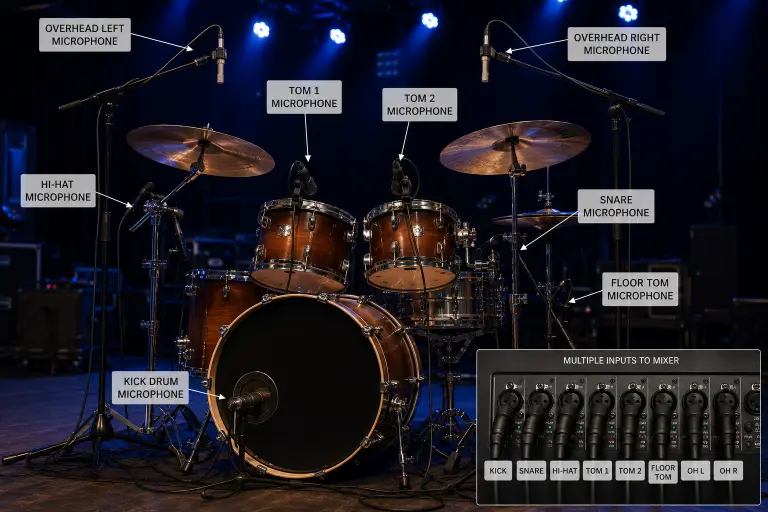
A full drum kit cannot be adequately captured with a single microphone positioned anywhere in the room. The acoustic character of each component of the kit, the kick drum's low-frequency impact, the snare's transient attack, the cymbals' high-frequency detail, is different enough that a single microphone captures some components clearly and others poorly.
Professional drum kit microphone setups use individual microphones on each primary component: a dedicated kick drum microphone designed to handle the high sound pressure levels at the beater point, a snare microphone positioned to capture attack without excessive bleed from adjacent cymbals, individual microphones on each tom, and overhead microphones capturing the overall cymbal pattern and room sound.
This multi-input approach gives the engineer individual control over every component of the kit's sound, the ability to shape tone and balance between elements, and the capacity to prevent phase issues that arise when multiple microphones capture the same source at different distances.
Live Instruments
Instruments like acoustic guitar, violin, saxophone, and similar instruments present a different challenge: capturing the natural detail of the instrument while rejecting the ambient stage noise that surrounds it.
Microphone placement relative to the instrument is the primary tool. Different positions on the same instrument produce dramatically different tonal characters. The right placement maximizes the detail and character of the instrument's natural sound while minimizing the bleed from adjacent sound sources on stage.
Performer movement is a complicating factor. An instrumentalist who moves relative to a fixed microphone position changes the microphone-to-instrument distance and angle continuously, which produces volume and tonal variation in the mix. The engineer monitors and adjusts for this variation in real time.
The System Behind the Sound: Signal Flow and Routing
Every microphone in a live event production is a starting point, not an endpoint. The signal from each microphone travels through a signal chain that determines what the audience ultimately hears, and every link in that chain has the potential to improve or degrade the quality of the sound.
The mixing console is the control center of the entire audio system. Every microphone signal arrives at the console, where the engineer adjusts gain, applies EQ and dynamics processing, and controls the level of each source relative to every other source in the mix. This is where the individual microphone decisions become a unified audio program.
From the console, audio is routed to:
Front-of-house speakers delivering the program to the audience. Speaker placement and coverage pattern determine whether every audience member hears a consistent mix or whether some areas of the room are louder, quieter, or tonally different from others.
Stage monitors and in-ear monitor systems deliver a separate mix to performers that allows them to hear themselves and each other clearly while performing.
Recording systems capture the program for post-event use, distribution, or archival purposes.
Live streaming outputs require a separately optimized mix that serves the stream's audio environment rather than repurposing the in-room mix without modification.
This signal routing structure is what the term "signal flow" describes in professional audio. Managing it correctly requires understanding not just how each component works independently but how every decision at one point in the chain affects what happens at every subsequent point.
Monitoring: What Performers Hear Shapes What the Audience Hears
Performer monitoring is one of the most frequently underappreciated elements of live event audio, and its relationship to front-of-house sound quality is direct.
Performers who cannot hear themselves clearly in their monitors compensate instinctively: vocalists sing louder or change their approach to their microphone, instrumentalists play harder, and the natural performance dynamic that the audience is meant to experience shifts in response to the monitoring problem.
Stage monitors (wedges) are speakers positioned on the stage floor facing the performers. They deliver a real-time mix of the program as the performer needs to hear it, which is typically different from the front-of-house mix the audience hears. The monitor mix for a vocalist might emphasize their own voice and a keyboard guide track. The monitor mix for a drummer might emphasize a click track and a vocal guide. Each performer's needs are different and each monitor mix is configured independently.
In-ear monitors (IEMs) deliver the monitor mix through earphones worn by the performer rather than through stage speakers. This approach reduces the stage volume created by multiple wedge monitors operating simultaneously, which in turn reduces the ambient noise that front-of-house microphones pick up from the stage. Cleaner stage sound makes the front-of-house mix cleaner.
Both systems require precise setup and the same pre-event ringing out process that prevents feedback in the front-of-house system. A stage monitor that feeds back is a disturbance that every person in the venue hears.
Preparation Is What Prevents Problems
The most consistent principle in professional live event audio is that problems that appear during the event were preventable during setup.
Ringing out the system, a process of identifying and reducing the specific frequencies most likely to cause feedback in a given room, is the foundational preparation step for any live event with amplified sound. The process involves raising the gain of the system until feedback begins to develop, identifying the frequency at which it occurs using an analyzer, applying a notch filter to reduce that frequency, and repeating the process until the system can operate at the required gain level without feedback risk.
This process is completed before the audience arrives and before performers take the stage. It is not visible to anyone in the room, but its absence is immediately audible when it has not been done.
From Portland Production Services' field experience: the first assessment in any new venue begins with speaker placement. Speakers positioned in an unfavorable relationship to microphones create feedback at gain levels that should be safe. Understanding the room's acoustic character, where sound bounces, where dead zones exist, how different frequency ranges behave in the specific space, then informs every subsequent decision about EQ, microphone placement, and system configuration.
The work that happens before the event starts is the work that determines whether the event sounds professional.
Why Equipment Is Secondary to Engineering
A common assumption in live event planning is that better equipment produces better sound. The assumption is partially true and mostly misleading.
Professional-grade microphones, mixing consoles, and speaker systems have genuine performance advantages over consumer-grade alternatives. They handle higher sound pressure levels, have more predictable and consistent frequency responses, and provide more precise control over the audio signal at every stage of the chain.
But the most important variable in any live event audio system is the engineer managing it in real time.
A sound engineer coordinates wireless frequency assignments to prevent interference between systems. They adjust gain and EQ decisions dynamically as speakers change and ambient conditions shift throughout the event. They monitor the signal flow from every microphone through every routing point to every output simultaneously. They identify and resolve problems before those problems reach the audience, which requires both technical knowledge and the pattern recognition that comes from experience across many different venues and event formats.
The right microphones for a live event in the hands of an inexperienced operator produce unpredictable results. The same microphones in the hands of an experienced engineer who understands the full system produce consistent, professional sound throughout the event.
This is why professional live event audio is always discussed as a system, not as an equipment list.
Live Event Audio and Production Services
The table below outlines what Portland Production Services delivers for live event audio and full-scale event production.
Event Production and Live Streaming- Full live event audio, video, lighting, and streaming production with professional engineering. Corporate conferences, galas, concerts, commencement ceremonies, fundraisers
Commercial Video Production- Pre-produced video content for integration into live event programming. Organizations incorporating branded video into live events
Corporate and Training Videos- Recorded content from live events repurposed for internal training and communication. Companies capturing knowledge from live events for ongoing team use
Marketing and Promotional Videos- Event recap and highlight content from professionally recorded live events. Brands and organizations extending event impact beyond the day itself
Nonprofit Storytelling- Live-captured story content from nonprofit galas and fundraising events. Nonprofit organizations producing high-stakes fundraising and stewardship events
Good Sound Starts With the Right System, Not Just the Right Microphone
The best microphones for a live event are the ones selected for the specific format, the specific performers, and the specific acoustic environment of the venue they will be used in. But the selection is only the first decision in a long chain of decisions that determines whether the audience hears what the event is designed to communicate.
Signal flow, monitoring systems, system tuning, wireless coordination, and real-time engineering are all part of what professional live event audio actually involves. An experienced sound engineer who understands how every part of the system interacts is what makes all of those decisions produce a consistent, professional result throughout the event.
Portland Production Services brings twenty-plus years of live event audio experience, owned professional equipment, and dedicated engineering to every event it produces across Portland and the Pacific Northwest. When the audio has to be right from the first sound check to the final moment of the program, that is the standard that makes the difference.
Ready to Make Sure Your Event Sounds as Professional as It Looks?
Good audio is not noticed. Bad audio is the only thing anyone talks about. Portland Production Services handles live event audio, from microphone selection through system design, real-time engineering, and monitoring, so every person in your venue hears exactly what they came to hear. Tell us about your event and we will show you what professional sound actually requires.
Frequently Ask Questions
1: How do I choose the right microphones for a live event?
Choosing the right microphones for a live event requires evaluating who is speaking or performing, whether they are stationary or mobile, the acoustic character of the venue, how many microphones will be in use simultaneously, and whether the event is being recorded or live-streamed. Each variable influences which microphone type, pickup pattern, and wireless coordination approach is appropriate. There is no universal answer because the right microphone for one event format and environment is the wrong one for another.
2: Are wireless microphones better than wired for live events?
Wireless microphones offer significant flexibility advantages, particularly for presenters and performers who need to move freely. They also introduce technical requirements that wired microphones do not: frequency coordination to prevent interference between multiple wireless systems, battery monitoring throughout the event, and signal stability management in RF-dense environments. Whether wireless is better depends on the specific event format. A professional sound engineer makes this determination based on the event's actual requirements.
3: What is the most common audio problem at live events?
Feedback and inconsistent volume are the most commonly experienced audio problems at live events, and both are almost always the result of inadequate system preparation rather than equipment failure. Feedback occurs when the gain of the system exceeds the room's tolerance at specific frequencies, typically because the system was not properly rung out before the event. Inconsistent volume occurs when gain levels are not properly adjusted for different speakers or when the monitoring system is not correctly configured for the venue.
4: How important is the sound engineer compared to the microphone selection?
The sound engineer is more important. Professional-grade microphones for a live event in the hands of an inexperienced operator produce unpredictable results. The same microphones managed by an experienced engineer who understands signal flow, real-time gain management, wireless coordination, and acoustic problem-solving produce consistent, professional sound throughout the event. Equipment defines the upper limit of what is achievable. Engineering determines whether that limit is actually reached.
5: Can small or simple events skip professional audio setup?
Small events can sometimes operate with basic audio setups, but the risk profile is different than most event planners assume. Poor audio at any event, regardless of size, affects how every attendee experiences the content. For events where the message being communicated matters, where presenters are expected to be clearly heard, or where a professional impression is important, professional audio setup significantly reduces the risk of the kind of audio problems that are immediately noticeable and impossible to ignore once they occur.
6: How does Portland Production Services approach live event audio?
Portland Production Services approaches every live event audio engagement as a full system design rather than an equipment selection. The team evaluates the venue's acoustic character, selects microphone types and configurations appropriate to the specific event format, coordinates wireless systems to prevent interference, rings out the system before the event begins, and provides dedicated real-time engineering throughout the program. Every decision is made in service of what the audience needs to hear clearly from the first moment to the last.
Key Takeaways
- Choosing the right microphones for a live event requires understanding the format, the performers, the venue's acoustics, and the number of simultaneous sources before any equipment is selected. There is no universal best choice.
- Podium, handheld, lavalier, and vocal microphones each have specific strengths and technical demands. Lavaliers are the most flexible for presenter movement and the most demanding to execute consistently.
- Complex setups involving drum kits and live instruments require multiple microphones per source and give the engineer individual control over every element of the sound, which is essential for professional-quality live production.
- Signal flow, monitoring systems, pre-event system tuning, and real-time engineering are all as important as microphone selection. The engineer managing the system is the most critical variable in whether the event sounds professional.
- Portland Production Services provides complete live event audio services across Portland and the Pacific Northwest, from microphone selection and system design through professional real-time engineering and monitoring for events of every scale.
There's more ...


Unleash Your Inner Creative Madness With Us!
info@portlandproductionservices.com
503-317-6447
© Portland Production Services 2026
8816 SE 29TH AVE
MILWAUKIE OR 97222-6323, US

