

The Ultimate Guide to LED Video Wall Rental for Your Next Event
LED video wall rental requires more than choosing a screen—it starts with a clear purpose, which guides all technical decisions for a smooth, impactful event.
LED video wall rental involves more than choosing a screen size and showing up with panels. Resolution, pixel pitch, power requirements, rigging method, content preparation, signal flow, and placement all determine whether the wall enhances the event or creates production problems in front of a live audience. This guide covers every consideration in detail, including real field numbers from Portland Production Services' own event productions. When you are ready to plan your LED wall, Portland Production Services brings twenty-plus years of live event production experience to the process.
Start With Purpose, Not Specs
Before discussing resolution, pixel pitch, or LED video wall rental pricing, the most important question is the simplest one: what do you need the wall to do?
The answer to that question determines every specification that follows.
Some events need an LED wall for clarity. Corporate conferences with dense slides and detailed data visualizations benefit from a bright, crisp display that remains fully readable even with full house lights on. A washed-out projection screen is not an option when the presentation is the product.
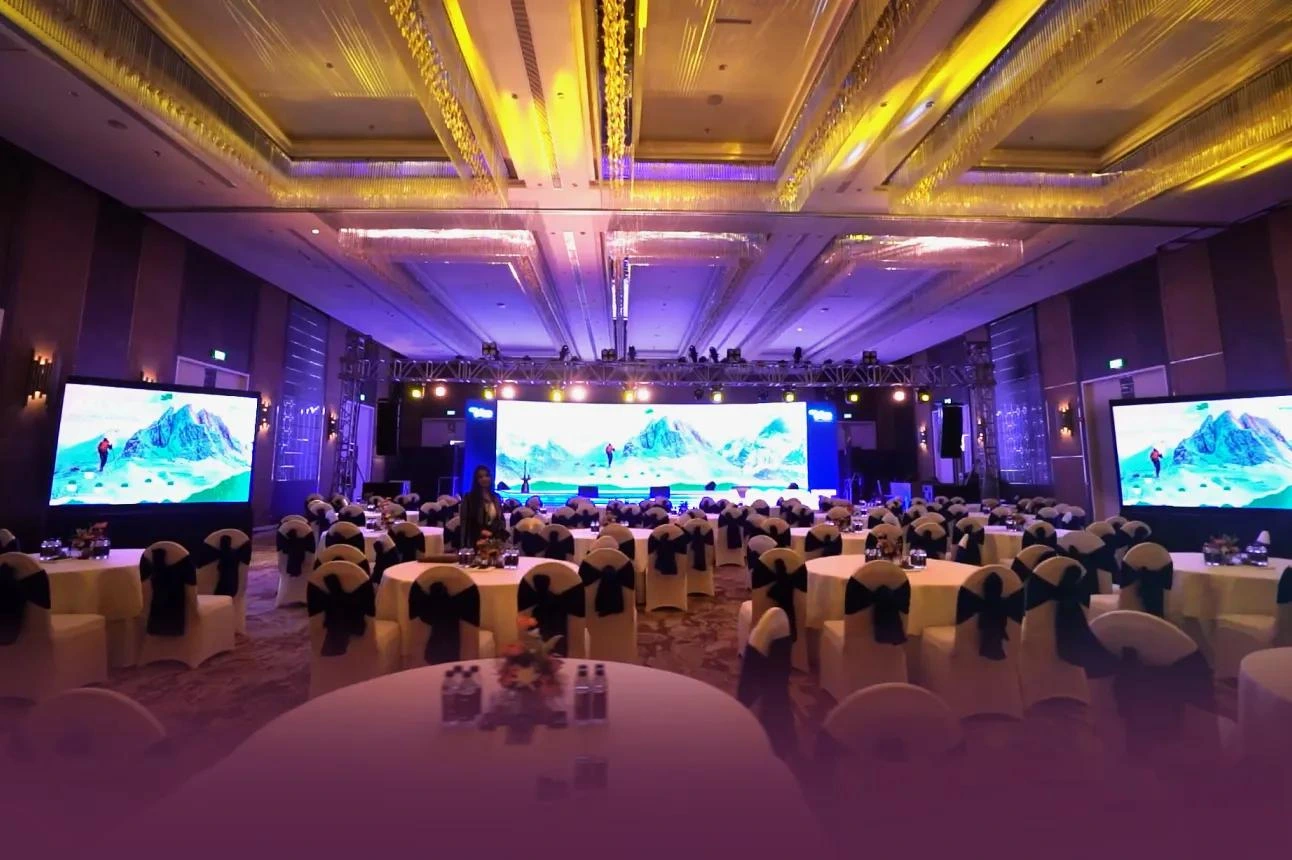
Some events need it for ambiance. Weddings and galas use LED walls to display moving visuals, branded content, and atmospheric imagery that sets the tone of the evening without overwhelming the décor or the program.
Other events use LED walls for connection. Live camera feeds displayed on a large LED surface allow guests seated in the back of a large venue to feel as present and engaged as those in the front row. This application, often called IMAG (image magnification), is one of the highest-value uses of an LED wall at large-format events.
Set the goal first. The size, resolution, placement, and content approach should all align with the role the wall is designed to play. Without a clear purpose, every subsequent decision defaults to guesswork.
Understanding Resolution and Pixel Pitch
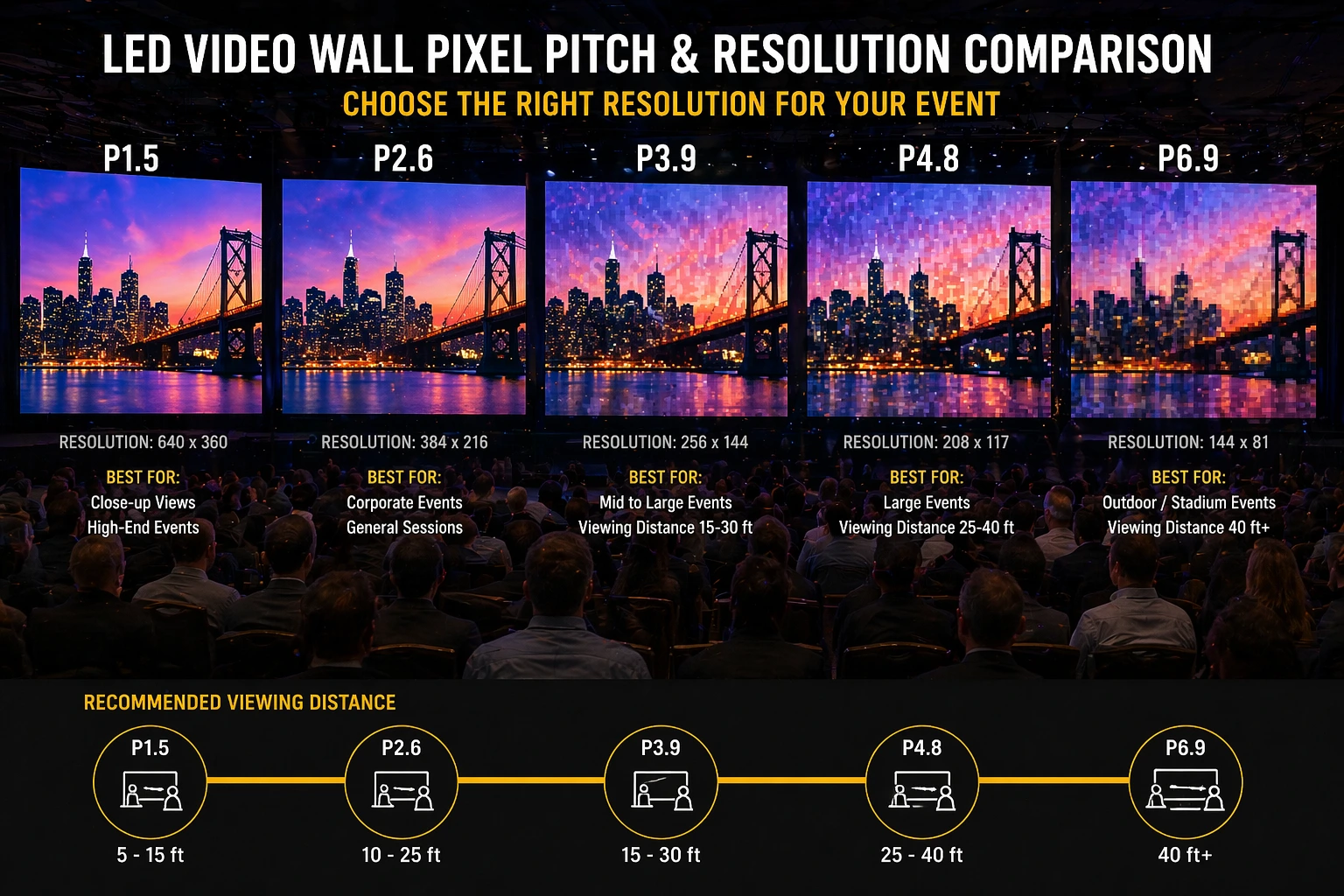
One of the most persistent misconceptions about LED video wall rental is that higher resolution is always better. It is not. The right resolution depends entirely on how far the audience is seated from the screen.
LED walls are measured in pixel pitch: the distance, in millimeters, between individual LED diodes. A smaller pixel pitch number means tighter diode spacing, which produces a sharper image at close viewing distances. A larger number means wider spacing, which is appropriate when the audience is farther from the screen.
Here is how pixel pitch maps to typical event scenarios:
P1.9 to P2.6: Best for indoor corporate events, wedding receptions, and panel discussions where guests are seated close to the stage. These configurations produce sharp text, clean graphics, and detailed visuals at short viewing distances.
P3.9 to P4.8: Best for larger ballrooms and outdoor environments where the first row of seating is already several feet from the screen. At these distances, the difference in pixel density becomes imperceptible, making a tighter pitch unnecessary and more expensive without visible benefit.
A practical field rule: the minimum comfortable viewing distance in feet roughly corresponds to the pixel pitch in millimeters. A P2.6 wall is comfortable from approximately eight feet and beyond. A P3.9 configuration performs well from roughly twelve to thirteen feet.
Overspending on ultra-tight resolution that the audience cannot appreciate at their actual viewing distance wastes budget. Choosing a wider pitch for a close-up audience makes text appear blocky and difficult to read. The goal is matching the specification to the event's layout, not selecting the highest number available.
Power Planning: The Detail Most Events Get Wrong
Power is one of the most frequently overlooked considerations in LED video wall rental, and one of the most consequential when it goes wrong.
LED walls draw significant electricity. The total amperage required depends on the size of the configuration and its brightness settings. Larger installations may require multiple dedicated circuits rather than shared venue power. Using clean, stable power sources is essential to prevent flickering, signal dropout, or mid-event interruptions during keynote moments.
From Portland Production Services' experience: most full-sized LED video walls require at least four 20-amp circuits, and sometimes more depending on the brightness level and total panel area. This is one of the first technical details evaluated before confirming any installation.
Venues often believe they have sufficient power capacity until load-in begins and the production team starts pulling actual circuit loads. Before confirming an installation, the following must be verified: the number of available circuits, the voltage provided (120V versus 208V or 240V), and the physical distance from the power source to the wall location. These variables affect both setup logistics and performance stability throughout the event.
For outdoor or temporary installations, generators introduce additional coordination, cost, and safety requirements that need to be planned well in advance.
When power is addressed correctly at the start of the planning process, the LED wall performs consistently from the first moment of the program to the last. When it is not, the problems become visible in real time in front of the audience.
Rigging and Safety
How an LED video wall is supported is as important as the screen itself.
Most installations use ground-supported truss systems, which are typically the most practical and cost-effective approach for standard event venues. Some configurations are flown from the ceiling, which requires venue approval, certified riggers, and a careful review of the ceiling's load ratings. Others are integrated into scenic builds or mounted against existing structures.
The right method depends on the total weight of the wall and its supporting structure, the available floor space, sight lines from all audience positions, and overall safety for guests and performers.
Flown installations frequently require engineered load calculations, advance site inspections, and additional labor hours to confirm compliance with safety standards. This is not an area where shortcuts are available. Overlooking rigging requirements creates genuine safety risks and potential liability. Addressing them early in the planning process makes load-in smoother and the final installation feels exactly as it should: deliberate, stable, and secure.
Placement and Sightlines
An LED video wall should support visibility for every guest in the room, not just the ones in the center section.
Poor placement decisions are more common than they should be. Screens positioned too high force guests to crane their necks for an entire keynote. Screens positioned too low get partially blocked by décor, stage elements, or the guests seated in front of them. Screens that are not centered for the room's primary audience sightline create a left-side or right-side viewing disadvantage that no brightness level can compensate for.
Every placement decision needs to account for the full audience layout, the camera angles being used for live coverage or streaming, the lighting design, and the flow of the stage program. Sometimes a single large center wall is the right configuration. Other times, side screens provide better coverage for a wide audience spread across a large ballroom.
Every venue is different. Every audience layout is different. Placement decisions that are made quickly without a thorough site evaluation tend to reveal their problems during the event rather than before it.
Content Preparation
An LED video wall rental is only as strong as the content displayed on it.
Slides designed for a laptop screen do not automatically translate well to a large LED surface. Thin fonts, overly complex graphics, and content built at low resolution can all appear difficult to read or visually inconsistent when scaled to a large display. Every piece of content intended for the LED wall should be tested at the actual output resolution before the event begins.
For events that include live camera feeds, hybrid streaming, or multiple simultaneous input sources, coordination between the LED system and the video switching setup becomes essential. In-person audiences and remote viewers need to receive a consistent, well-managed visual experience. Content management is not a detail to address on event day. It is a pre-production step.
The LED wall itself is an excellent display surface. What appears on it determines whether guests are impressed or indifferent.
Video Processing and Signal Flow
Behind every LED video wall is a processing and signal management system that makes the display function seamlessly.
The wall does not simply play content. A video processor maps the image correctly across all panels, scales incoming signals to the proper resolution, and ensures every panel in the configuration displays the correct portion of the image. Switchers manage multiple inputs simultaneously, whether those are presentation slides, live camera feeds, embedded videos, or a presenter's laptop.
For complex event programs, this system becomes more layered. Corporate conferences may require several simultaneous input sources. Galas may alternate between live camera magnification and pre-produced video content. Award ceremonies may need to coordinate slides, presenter feeds, and video packages across a tightly scripted program.
Signal runs may use SDI, HDMI, or fiber depending on the distance between source and display and the reliability requirements of the event. For mission-critical programs, redundant signal paths and failover systems are implemented to protect against unexpected interruptions.
When signal flow is designed and tested correctly, transitions between content sources feel effortless and the audience never sees the technical infrastructure working behind the experience. When it is not, transitions drop, screens go black, and those moments happen in front of everyone.
Indoor Versus Outdoor LED Video Wall Installations
Outdoor LED video wall installations involve a different level of planning than indoor setups, and that difference is significant.
Brightness: Outdoor environments require significantly higher brightness levels, measured in nits, to remain visible in daylight. Sun angle and glare also affect how content appears at different times of day, particularly during afternoon events where direct sunlight hits the screen surface.
Weather resistance: Outdoor panels and all associated connections must be rated for environmental exposure. Moisture, humidity, and temperature variation all affect both the equipment and the signal infrastructure.
Wind load: Outdoor walls require proper ballast, heavier trussing, and secure structural engineering to remain stable in wind conditions. These builds typically involve a larger crew, a longer setup window, and more extensive safety verification before the event begins.
Permitting: Depending on the venue and location, city approvals or permits may be required for an outdoor LED installation of significant size.
Outdoor LED wall rental is absolutely achievable and can produce extraordinary results. It simply requires more advanced coordination and contingency planning than an equivalent indoor installation. When those considerations are addressed early, the wall performs reliably regardless of what the weather decides to do.
What Does LED Video Wall Rental Actually Cost?
From Portland Production Services' direct experience producing events with LED video walls: costs typically range from $2,500 to $15,000 depending on the size of the configuration, the pixel pitch specification, the complexity of the signal management system, and the overall production requirements of the event.
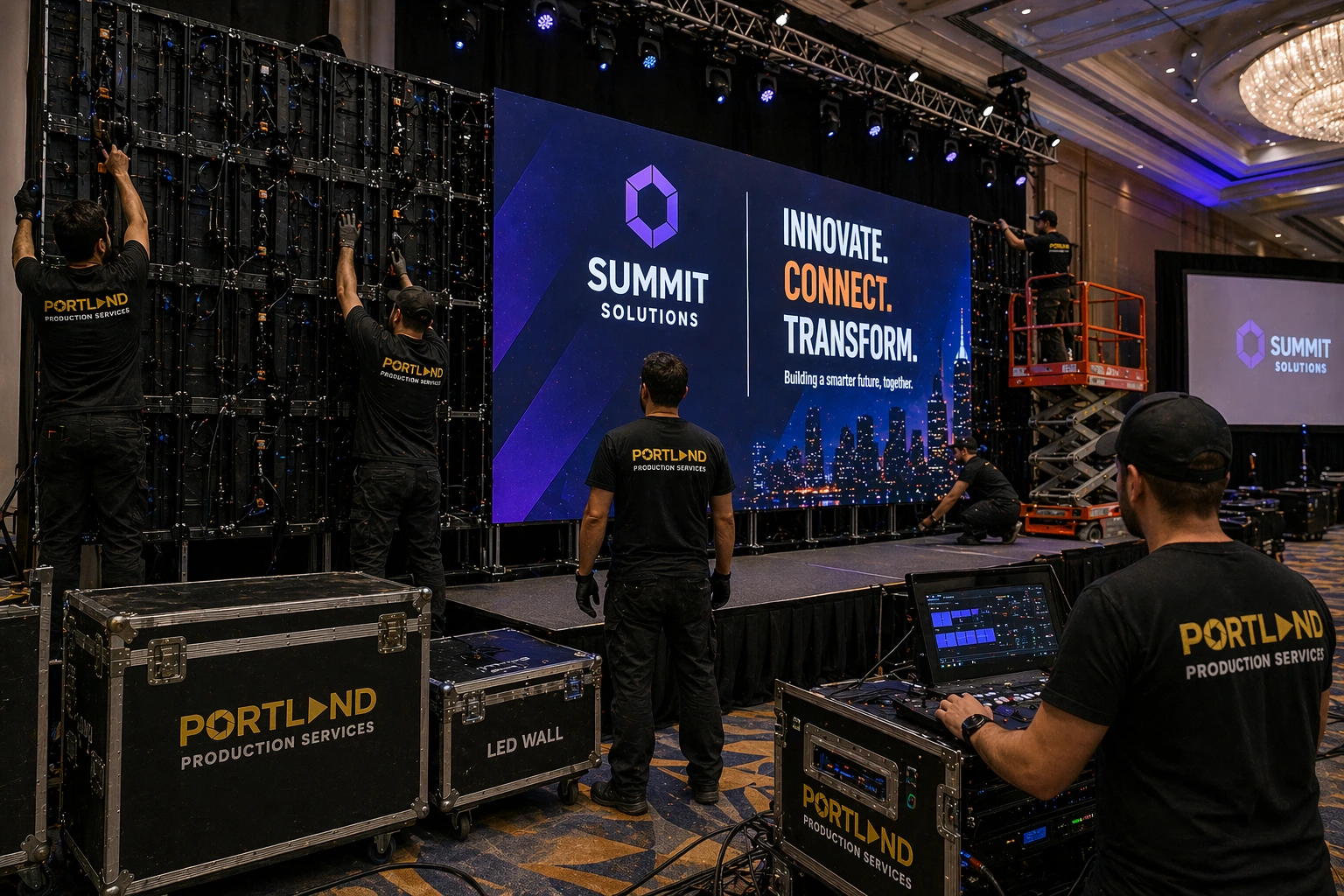
Setup time for a complete wall installation typically runs between two and five hours. That range depends on the type and size of the configuration, whether the installation is ground-supported or flown, and how the system is being integrated with the broader audio and lighting production.
What those numbers cannot capture is the qualitative difference between an LED video wall and every alternative display option. The clarity, brightness, presence, and visual authority of a properly installed LED wall are not comparable to projection screens or consumer displays. The impact on how a room feels and how the event is perceived by every guest in it is not marginal. It is the difference between an event that looks professional and one that looks premium.
For a custom quote based on your specific event, venue, and production requirements, contact Portland Production Services directly.
LED Video Wall and Event Production Services
The table below outlines the event production services offered by Portland Production Services and how each one supports a complete LED video wall production.
Service
What It Delivers
Best For
Event Production and Live Streaming
Full-scale AV production with LED video walls, multi-camera coverage, and streaming
Conferences, galas, product launches, award ceremonies
High-impact branded content designed for LED wall display at events
Corporate campaigns, product launches, branded event content
Presentation content, onboarding, and communication video formatted for large display
Corporate events, internal communications, conference presentations
Mission-driven video content optimized for gala and fundraiser LED display
Nonprofit galas, donor events, cause-driven celebrations
Marketing and Promotional Videos
Brand and campaign video formatted for event display and live streaming integration
Brand activations, promotional events, experiential campaigns
An LED Wall Works When the Planning Does
LED video wall rental for events delivers extraordinary results when the planning behind it is as deliberate as the technology itself. Purpose, resolution, power, rigging, placement, content, and signal flow are not independent decisions. They are interconnected, and getting any one of them wrong affects all the others.
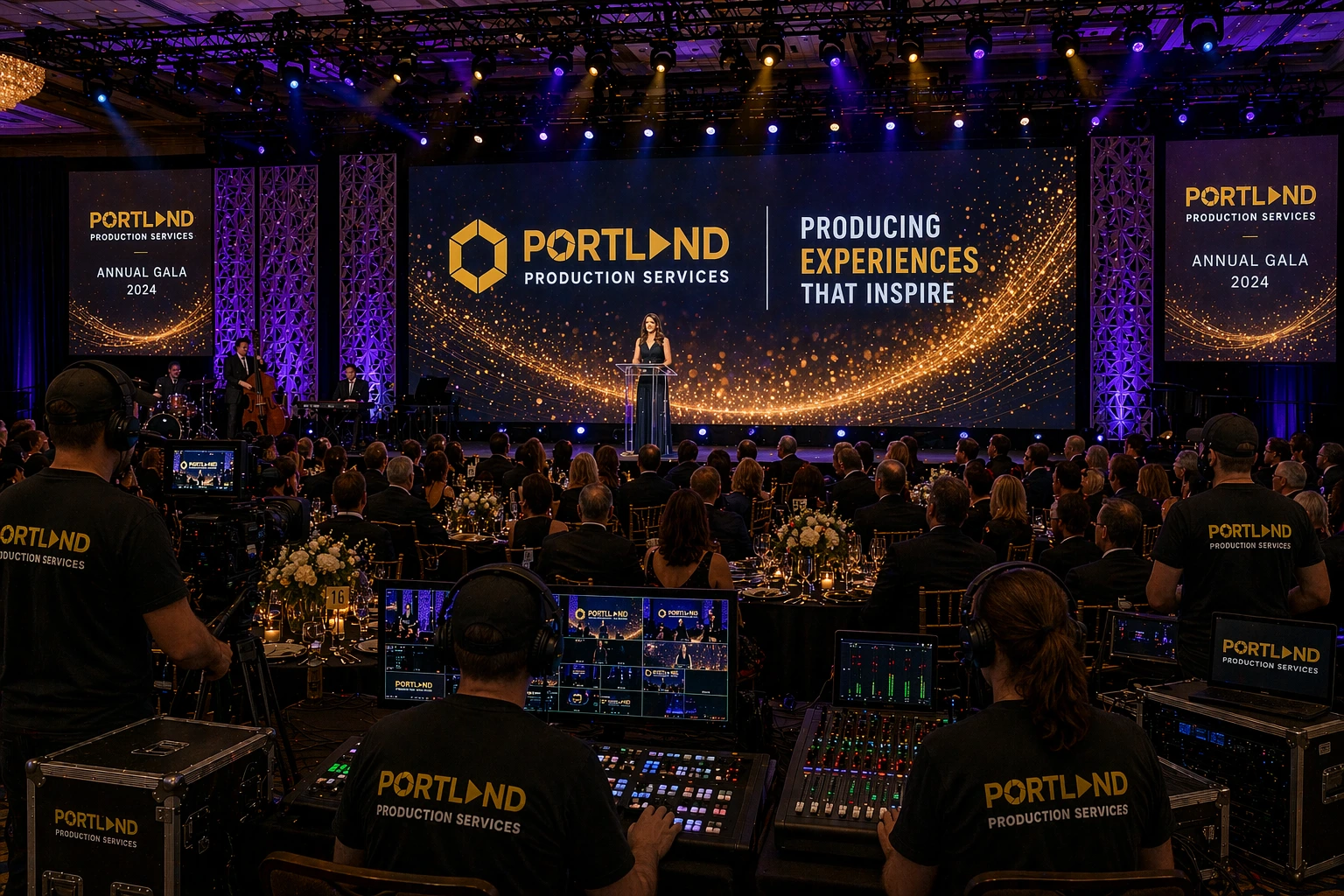
Portland Production Services approaches every LED video wall deployment as part of a complete production plan, not as a standalone rental. The wall integrates with the audio, lighting, video capture, and streaming systems to produce an event where every element works together and the technology stays invisible to the audience. Portland Production Services brings twenty-plus years of live event production experience to every installation.
Ready to Plan Your LED Video Wall Rental?
Your event deserves a display that matches its ambition. Portland Production Services walks you through every decision, from pixel pitch to power planning to content preparation, and delivers an LED video wall installation that performs from the first moment to the last. Tell us about your event and we will tell you exactly what it takes to make it extraordinary.
Frequently Ask Questions
1: What is LED video wall rental and what does it include?
LED video wall rental covers the supply, delivery, installation, configuration, and on-site technical management of a modular LED panel system for an event. A professional rental includes the LED panels, the processing and signal management hardware, the rigging or support structure, content coordination, and a technical crew responsible for setup, operation, and teardown. It is a full production service, not a drop-and-go equipment delivery.
2: How do I choose the right LED video wall resolution for my event?
Resolution for an LED video wall is measured in pixel pitch. For indoor events with close viewing distances such as corporate conferences and wedding receptions, P1.9 to P2.6 configurations produce sharp, detailed visuals. For larger venues where the audience is farther from the screen, P3.9 to P4.8 configurations are appropriate and more cost-effective. The practical rule is that comfortable minimum viewing distance in feet roughly corresponds to the pixel pitch value in millimeters.
3: How much power does an LED video wall require?
Most full-sized LED video walls require a minimum of four dedicated 20-amp circuits, and sometimes more depending on the configuration size and brightness settings. Venues should confirm the number of available circuits, the voltage provided, and the distance from the power source to the wall location before finalizing any installation plan. Portland Production Services evaluates power requirements as one of the first technical steps in every event planning process.
4: How long does it take to install an LED video wall for an event?
Installation of a complete LED video wall typically takes between two and five hours depending on the configuration size, the rigging method used, and the complexity of the signal management integration. Load-in timing needs to be confirmed with the venue well in advance to ensure the installation window fits within the available schedule without compressing other production setup.
5: What does LED video wall rental cost?
LED video wall rental costs typically range from $2,500 to $15,000 depending on the size and pixel pitch of the configuration, the complexity of the signal and processing system, and the overall production requirements of the event. Every event is scoped individually. Contact Portland Production Services directly for a custom quote based on your specific event, venue, and goals.
6: Can Portland Production Services handle both the LED wall and the full event production?
Yes. Portland Production Services integrates LED video wall production as part of a complete event production plan that includes audio, lighting, live camera coverage, streaming, and content management. Every technical element is coordinated by a single production team, which means the wall works with the surrounding production rather than alongside it. This integrated approach is what makes the final experience feel seamless.
Key Takeaways
- LED video wall rental is a production service, not a product delivery. Resolution, power, rigging, placement, content, and signal flow all require advance planning and professional execution.
- Pixel pitch should be matched to the audience's actual viewing distance. Higher resolution is not always better. It is only better when the audience is close enough to perceive the difference.
- Power planning is one of the most critical and most overlooked steps in any LED wall installation. Most full-sized walls require at least four dedicated 20-amp circuits, and power capacity should be verified before installation is confirmed.
- Outdoor installations require significantly more planning than indoor setups: higher brightness ratings, weather protection, wind load management, and potentially permitting.
- Portland Production Services approaches every LED video wall rental as part of an integrated event production plan, with owned equipment, senior crew, and twenty-plus years of live event experience behind every installation.
There's more ...
Unleash Your Inner Creative Madness With Us!
info@portlandproductionservices.com
503-317-6447
© Portland Production Services 2026
8816 SE 29TH AVE
MILWAUKIE OR 97222-6323, US

