




The Complete Guide to Charity Video Production
Discover how ethical charity video production builds trust, tells authentic stories, and inspires lasting support for your organization's mission.
Charity video carries a burden that most video does not. It is made about people who often have less power than the organization filming them, shown to people who have more, in order to raise money that flows in one direction. Every choice in that chain, who holds the camera, whose language the film speaks, whose face appears, who was asked and who was told, is an ethical choice before it is a creative one.
This guide covers charity video production as it actually should be practiced: the films that move supporters, the safeguards that protect the people on screen, and the craft that lets both happen at once. It is the harder version of nonprofit video production, and it is the only version worth doing.
What Makes Charity Video Production Distinct
Charity video shares a toolkit with commercial and nonprofit video and almost nothing else.
The subjects are frequently people experiencing hardship, displacement, illness, or crisis. The audience is frequently people who will never meet them. The organization sits between the two, deciding what gets shown and what does not, and profiting, in the form of donations, from that decision.
That structural asymmetry is the defining fact of charity video production, and any guide that skips it in favor of camera settings has misunderstood the work. Everything below proceeds from it.
Who Holds the Camera Matters
The most consequential production decision in charity video is made before a frame is shot: who films it.
A crew that arrives from outside a community sees what outsiders see. They notice hardship because hardship is what contrasts with their expectation. They miss the ordinary competence, humor, and social texture that the community itself would consider the story. The resulting film is accurate in its details and false in its whole.
Work With Local Crew and Local Voice
Wherever it is possible, hire local camera operators, local sound recordists, local fixers, and local producers. Not as a diversity gesture, but because they will produce a truer film. They know who to ask, what is private, what is normal, and what an outsider is about to misread.
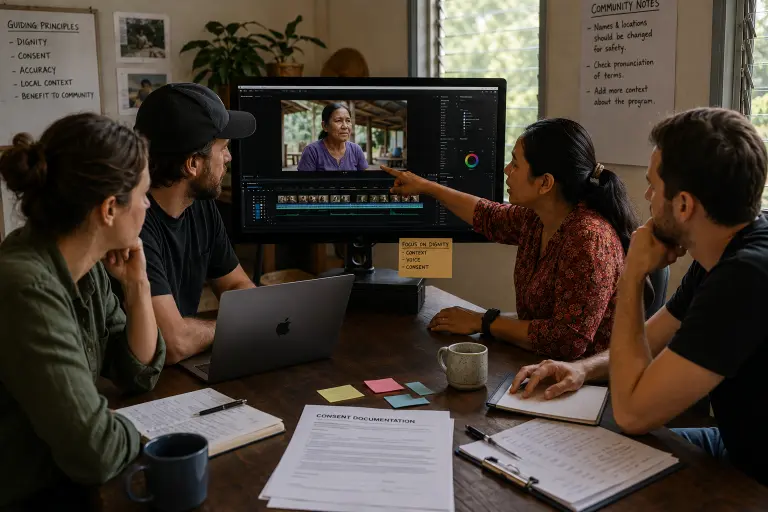
Where a local crew is not available, at minimum ensure local coordinators shape the story, review the edit, and hold real veto power rather than ceremonial input.
Let People Narrate Themselves
Voiceover explaining a person's life over footage of that person living it is the visual grammar of charity video's worst tendencies. It literally speaks over them. Subtitled speech in a person's own language, in their own words, is nearly always the stronger and more honest choice, and audiences respond to it more strongly than fundraising convention assumes.
Filming Across Lines of Power
Consent given by someone who depends on your organization for food, shelter, medical care, or legal status is not freely given unless you have worked very hard to make it so.
Consent Must Be Real, Not Procedural
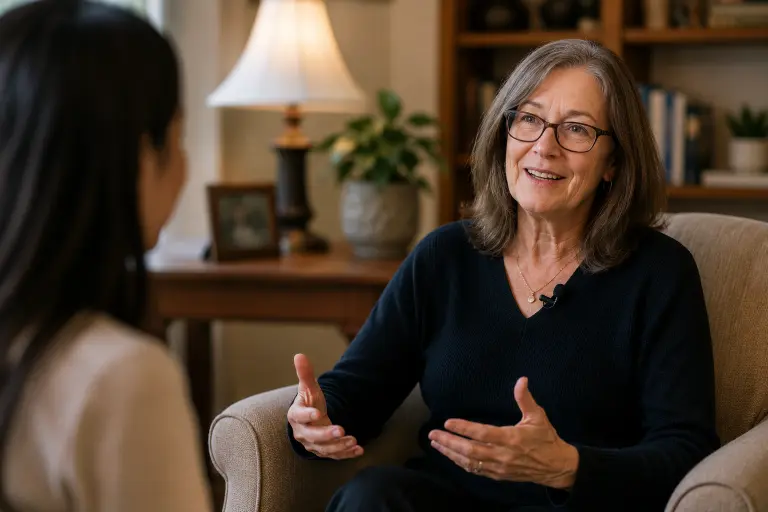
The person must understand where the film will appear, that it will be seen by strangers in another country, that it may remain online permanently, that they may be recognized, and that refusing carries absolutely no consequence for the services they receive. That last point must be stated explicitly, by someone other than the person delivering their services, and it must be believed.
Consent Is Revocable
A person who agreed on Tuesday may reconsider on Friday, or in five years. Charities that build a mechanism for withdrawal, and honor it, are the ones treating consent as a relationship rather than a signature.
Consent Across Languages
A release form in English signed by someone who does not read English is a document, not a consent. Translate it, explain it verbally through an independent interpreter, and record the explanation rather than only the signature.
Safeguarding Is Not Optional
Charity video regularly involves children, survivors of violence, people with insecure legal status, and people whose visibility could endanger them. Safeguarding is the practice of ensuring your film does not create the harm your mission exists to reduce.
Children require heightened protection. Do not identify children by full name, school, or location. Obtain guardian consent and the child's own assent. Never publish images of a child in distress that you would not publish of a child in your own family.
Anonymity is a production choice, not a post-production fix. If a subject's safety depends on not being identified, plan the shot to protect them rather than blurring a face afterward. Blurred faces are also a poor fundraising asset, which is precisely why the temptation to skip anonymity is strong and must be resisted.
Consider what identification enables. A film can reveal a location to an abusive spouse, an immigration authority, a hostile government, or a community that will ostracize a survivor. The person on camera may not have anticipated any of that. Your organization is obligated to.
The Image Ethics Every Charity Must Settle
There is a long standing argument in the charity sector about imagery, and organizations that have not resolved their position will drift into the worst of it under fundraising pressure.
The Case Against Suffering Imagery
Images that dwell on distress raise money quickly. They also strip subjects of dignity, teach audiences that entire regions or populations are helpless, flatten complex situations into pity, and produce donors whose engagement depends on continued spectacle. Over time, audiences habituate, and the imagery must escalate to keep working.
The Case for Not Sanitizing
The opposite failure is real too. Charity videos that show only resilience, smiling children, and successful outcomes can misrepresent genuine emergencies, minimize suffering that donors need to understand, and function as reputation management rather than communication.
Where the Line Actually Sits
The workable standard is agency. Show difficulty honestly, and show the people inside it as full human beings making decisions about their own lives. The question is not how much hardship to show, but whether the person on screen is presented as a subject with agency or an object of intervention.
A second useful test: would this person, watching this film, feel accurately and respectfully represented? If you cannot answer confidently, you have not asked them.
The Types of Charity Video
Different charity communications demand different films.
Emergency appeal videos are produced fast, in crisis, for immediate response. Speed defeats polish here. Honesty and clarity from someone standing in the affected place raises more than a beautiful film released three weeks later.
Field and program films show sustained work over time. These build donor understanding and are where local voice and local crew produce the most dramatic quality difference.
Supporter update videos report back to existing donors on what their money did. Charities systematically under-invest in these, and they are among the strongest retention tools available.
Advocacy and campaign videos target policy change rather than donations, and they are frequently the highest impact video a charity produces.
Volunteer and staff films support recruitment and internal culture, and organizations often produce these alongside their corporate and training videos for onboarding and safeguarding instruction.
Charities running public events, screenings, and fundraisers frequently pair the film with event production and live streaming so supporters who cannot attend still participate in the moment.
Practical Production Realities
Beyond ethics, charity production carries logistical demands that catch organizations off guard.
Translation and subtitling are core costs, not extras. Budget for professional translation, not a bilingual staff member squeezing it in. A mistranslated subtitle can misrepresent a person's own words to millions of viewers.
Plan for unreliable conditions. Power, connectivity, transport, and weather will not cooperate. Owned, well maintained equipment and crews who can improvise are worth more than the newest cameras.
Capture more than the story you came for. A single field visit is expensive. Plan the shoot to yield the emergency appeal, the program film, supporter updates, and social cuts, because returning is rarely possible.
Document consent as carefully as you document footage. Store releases with the footage, note what each person agreed to, and make that information available to whoever edits the film years later.
Stewardship of Donor Money in Production
Every pound or dollar spent on a charity film is money not spent on the mission, and supporters increasingly ask about it.
The answer is not to spend nothing. Underfunded video produces material too weak to use, and the money's gone regardless. The answer is to spend deliberately: concentrate budget on one properly produced film per year rather than several thin ones, batch production so a single field visit yields a year of assets, use real people rather than paid talent, and invest in audio and translation rather than exotic equipment.
Work with production partners who own their gear, because rental markups on charity invoices are donor money going to a rental house.
Charity Video Production in Portland and the Pacific Northwest
Portland hosts a substantial community of charities and humanitarian organizations working both locally and internationally, and the region's donor base is unusually attentive to how those organizations represent the people they serve.
Portland Production Services has produced video for Pacific Northwest organizations for more than 20 years, with fully owned equipment and an in-house crew across Portland, Beaverton, Hillsboro, Lake Oswego, Tigard, and Vancouver, WA. For charity work specifically, an experienced crew matters most in the room where a person decides whether to trust the camera. That trust is built by people who move slowly, explain everything, and are genuinely willing to leave without the footage.
Owned gear also protects the mission, since there are no rental markups on invoices paid with donor money, and no scheduling delays when an emergency appeal cannot wait for equipment.
Do It Well or Do Not Do It
Charity video production sits at the intersection of enormous fundraising power and real potential for harm. The organizations that navigate it well are not the ones with the biggest budgets. They are the ones who decided, in advance, whose story it is, who gets to tell it, what they will never show, and how they would want to be filmed themselves.
Get that right and the film raises money without costing anyone their dignity. That is the whole job.
Let's Tell Your Charity's Story Responsibly
Portland Production Services has helped Pacific Northwest organizations film with care for more than 20 years, with owned gear, an in-house crew, and a deep respect for the people whose lives appear on screen.
Book a consultation with Portland Production Services and bring us your mission and your concerns. We will talk through both before we talk about cameras.
Already worked with PPS? Share your experience in a quick review and help the next charity film with integrity.
Frequently Asked Questions
1.What is charity video production?
Charity video production is the creation of film for charitable organizations, typically featuring the people a charity serves and shown to supporters who fund the work. It carries a structural power imbalance between subject, organization, and audience, which makes consent, safeguarding, and image ethics core production concerns rather than afterthoughts. Done well, it raises money without compromising anyone's dignity.
2.How do charities film ethically?
Ethical charity filming means securing consent that is genuinely informed, freely given, and revocable, protecting children and anyone whose visibility could endanger them, working with local crew and letting people narrate themselves in their own language, and presenting subjects as people with agency rather than objects of intervention. The practical test is whether the person on screen would feel accurately and respectfully represented.
3.What is safeguarding in charity videos?
Safeguarding in charity video is the practice of ensuring a film does not create harm for the people it features. It includes protecting children's identities, planning anonymity into the shot rather than blurring faces afterward, and considering whether identification could expose someone to an abuser, an authority, or their own community. The organization carries this responsibility even when the subject has not anticipated the risk.
4.How much should a charity spend on video production?
Charities should spend deliberately rather than minimally, since underfunded video produces unusable material and wastes the money anyway. Concentrating budget on one properly produced film per year, batching production so a single field visit yields many assets, using real people instead of paid talent, and working with partners who own their equipment all stretch donor money furthest. Translation and audio deserve investment; exotic cameras do not.
Key Takeaways
- Charity video's defining fact is a power asymmetry between the people filmed, the organization filming, and the supporters watching, and every production decision follows from it.
- Who holds the camera changes the film. Local crew, local coordinators with real veto power, and subtitled speech in a person's own language produce truer and more persuasive work than outside crews with voiceover.
- Consent must be real, revocable, and understood, and safeguarding is a production choice, not a post-production fix, especially where identification could endanger a child or a survivor.
- Show hardship honestly and people with agency. The question is never how much suffering to show, but whether the person is a subject or an object. PPS brings 20+ years of experience, owned gear, and a crew willing to leave without the footage.
There's more ...


Unleash Your Inner Creative Madness With Us!
info@portlandproductionservices.com
503-317-6447
© Portland Production Services 2026
8816 SE 29TH AVE
MILWAUKIE OR 97222-6323, US

