



Professional Video vs DIY Video: What Businesses Need to Know in 2026
Professional and DIY video serve different roles in business strategy. DIY focuses on speed and authenticity, while professional video builds trust and credibility. Successful brands use both intentionally based on purpose.
Professional video and DIY video are not competitors. They are tools that serve different functions in a complete business video strategy. DIY video handles speed, consistency, personality, and volume. Professional video handles trust, clarity, brand perception, and the moments that shape how prospects and clients evaluate your business. The companies that win with video in 2026 are not choosing one over the other. They are using both with intention, knowing exactly when each one is the right tool for the job. This guide gives you the framework for making that decision. Portland Production Services handles the professional side of that equation for businesses across Portland and the Pacific Northwest.
The Biggest Mistake Businesses Make With Video
The most expensive video mistake is assuming all business videos should be made the same way.
That assumption leads to two failure modes.
Some businesses hire a production company for every piece of content, including quick social clips, casual team updates, and time-sensitive posts that genuinely did not need a full crew. This creates inefficiency and often produces polished content in contexts where something more immediate and human would have performed better.
Other businesses attempt to produce everything in-house on a phone, including homepage videos, brand films, customer testimonials, sales videos, and high-trust content that needed professional lighting, audio, editing, and storytelling to accomplish what it was supposed to accomplish.
Both extremes produce the same result: a video strategy that does not match the investment to the outcome.
The right approach is to match the production level to the business goal. Not every post needs a full crew. Not every piece of content should be shot on a phone. The question is always: what does this specific video need to accomplish, and what level of production does that outcome require?
When DIY Video Makes the Most Sense
DIY video works best when speed and frequency matter more than polish.
The content types where DIY video consistently performs well include social media updates, behind-the-scenes content, quick team opinions, day-in-the-life clips, event snippets, informal customer FAQs, culture and team content, and fast reactions to industry topics or current events. These videos often outperform more produced alternatives in their specific contexts because they feel immediate, authentic, and easy to consume.
DIY video is usually the right production choice when:
The content needs to be published quickly. By the time a polished production is planned, scheduled, shot, and edited, the moment may have passed.
The posting frequency is high. Maintaining a consistent social media presence across multiple platforms requires a volume of content that professional production economics cannot efficiently support.
The topic is conversational and simple. An FAQ answer, a team introduction, or a behind-the-scenes setup clip does not benefit from cinematic treatment.
Authenticity matters more than polish. On social platforms where overproduced content can feel stiff or corporate, a direct, human-feeling video from the owner or team lead often generates more genuine engagement.
The content is short-lived. Stories, time-sensitive posts, event-day clips, and trend reactions have a limited shelf life. Investing in professional production for content that will be irrelevant in 48 hours is misaligned.
For example, a Portland business that wants to answer quick customer questions on Instagram, share a project update, show a behind-the-scenes setup, or react to a relevant industry development can produce that content effectively with a phone and good lighting. In those situations, waiting three weeks for a polished production is the worse marketing decision, not the more professional one.
Why DIY Video Is Genuinely Valuable in 2026
DIY video gives businesses something they frequently struggle to maintain with professional-only content: momentum.
A business can produce more frequent content when it is not waiting on scheduling, location scouting, crew coordination, approvals, and full post-production every time. That frequency keeps the brand visible, enables faster response to questions and opportunities, and builds the kind of consistent presence that compounds over time in algorithm-driven content environments.
It also produces something that is difficult to replicate with professional production in certain contexts: the feeling of a real person communicating directly. A phone-recorded video from the owner, a sales team member, or a project lead can feel more credible and relatable on social platforms than a polished branded video, particularly when the audience is evaluating whether they want to work with actual people, not a production company's version of a brand.
That does not mean poor quality is acceptable. It means appropriate quality matters more than absolute quality. A clear, well-lit, direct DIY video on a relevant topic can absolutely outperform a cinematic production that is disconnected from what the audience actually wanted to know.
Where DIY Video Breaks Down
DIY video becomes a liability when the stakes are high and the production quality signals something the business did not intend to signal.
Poor lighting, inconsistent audio, cluttered or distracting backgrounds, unfocused delivery, and sloppy editing do not just make a video look unpolished. They create doubt about the business behind it. People infer competence, seriousness, and organizational quality from the way a business presents itself visually. That inference is fast, subconscious, and difficult to reverse once it has been made.
A casual social clip receives grace from viewers because they expect social content to be informal. A homepage video, a service explainer, a customer testimonial, a recruiting video, or any content that lives at a high-visibility decision point in the customer journey gets evaluated by a different standard. The question the viewer is asking at those moments is whether this business is credible and capable enough to trust with a purchase, a project, or a career decision. Production quality is one of the signals that answers it.
This is where professional video starts to matter a great deal more.
When Professional Video Makes the Most Sense
Professional video is the right production choice when trust, clarity, and brand perception directly affect revenue.
That includes:
- Website homepage and hero videos
- Company overview and brand story videos
- Customer testimonial and case study videos
- Service explainer videos
- Recruiting and culture videos
- Event recap and highlight videos
- Video advertising creative
- Sales enablement videos
- Product or service showcases for premium offerings
- Content that will be reused across multiple channels for extended periods
These are the videos that live in important places, get reused for months or years, and most directly shape how prospective customers perceive the business. If they look weak, they create doubt at exactly the moments when the business most needs confidence.
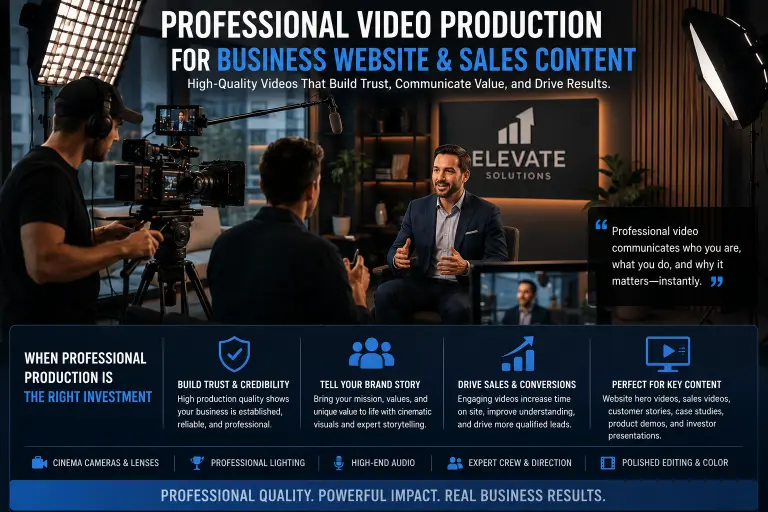
Professional production matters because it improves the things viewers notice without consciously identifying: sharper visuals with intentional composition, cleaner audio that removes the barrier between the message and the viewer, stronger pacing that holds attention through the full length of the video, better on-camera coaching that produces confident and natural interview performances, and more intentional editing that shapes a story rather than assembling footage.
For businesses competing in markets where first impressions are high-stakes and where the purchase decision is significant, those qualities can make the difference between a visitor who converts and one who continues evaluating alternatives.
Why Professional Video Still Matters When More Content Is DIY
The increase in in-house video production has not reduced audience expectations for content that matters. In contexts where quality signals credibility, the expectation for what professional-level video looks and sounds like has continued to rise rather than fall.
The key distinction is between casual and careless. DIY video in casual contexts is not held to professional production standards, and it should not be. But content at high-visibility decision points is evaluated precisely because it signals how seriously the business takes its own presentation.
Professional video remains the best fit when the content needs to:
- Create a strong first impression with prospects who have no prior relationship with the business
- Explain a complex service, process, or value proposition with clarity and persuasive structure
- Build trust with high-value prospects who are evaluating expensive decisions
- Represent a brand that positions itself in a premium tier of its market
- Generate long-term marketing value across multiple channels and use cases
- Support conversion on pages where the video's performance is directly measurable
The question is always whether the video's purpose requires that level of investment. When it does, professional production is what makes the investment pay off.
The Layered Strategy: How the Two Work Together
The strongest business video strategy is not professional video or DIY video. It is both deployed with clear purpose.
DIY video handles consistency. Regular social content, team updates, quick customer questions, behind-the-scenes clips, trend reactions, and event-day content all benefit from the speed and frequency that in-house production enables.
Professional video handles cornerstone assets. Homepage videos, brand films, testimonial reels, service explainers, recruiting videos, and ad creative all benefit from the quality, clarity, and longevity that professional production delivers.
That combination provides both volume and quality. It allows the budget to be invested intentionally: DIY production covers the content that benefits from frequency, professional production covers the content that benefits from excellence.
The practical result is a brand that feels both active and credible. The DIY content keeps the brand present and human. The professional video content establishes the brand's positioning and builds the trust that makes the frequent, casual content more valuable.
A Framework for Making the Decision
Before creating any business video, five questions clarify which production approach is the right one.
What is this video supposed to accomplish? A video designed to answer a quick customer question has different requirements than one designed to convert a prospect who is evaluating a significant purchase.
Where will the video live? Content on a social feed is consumed differently than content on a homepage or in a sales proposal. The distribution environment shapes the quality standard.
How long will we use it? Content that will be relevant for 48 hours does not warrant the same investment as content that will represent the brand for two years.
How important is trust and brand perception at this stage? For a viewer who is deciding whether to request a consultation, trust is the primary variable. For a viewer who is just getting to know the brand, authenticity and relatability may matter more.
Do we need speed, polish, or both? Some situations require an immediate response. Others require a considered, produced asset. Most businesses need both at different moments.
If the answers point toward immediacy, frequency, and human connection, DIY video is the right choice. If they point toward trust, conversion, authority, brand positioning, and long-term use, professional video is the investment that pays off.
What Businesses Should Avoid
Three patterns consistently produce underperforming video strategies.
Assuming a phone video is always good enough. Sometimes it genuinely is. In high-stakes contexts, it absolutely is not. The distinction requires honest evaluation of where the video will live and what it needs to accomplish.
Assuming expensive production automatically performs better. A polished video with generic messaging, weak strategy, and no clear purpose can underperform a direct, well-structured DIY video. Production quality amplifies the message. It cannot replace it.
Creating video without knowing its job. Every video should have a defined purpose: attract attention, build trust, explain a service, answer a specific question, support a conversion goal, or nurture an existing relationship. Without that clarity, the production level becomes a guess and the result is content that exists without a function.
How This Affects SEO Performance
Professional video and DIY video can both support search visibility, but through different mechanisms.
DIY video supports SEO primarily through volume and relevance: faster publication, more frequent coverage of questions the audience is searching for, and a higher rate of content creation that covers more of the topics the business's audience cares about.
Professional video supports SEO primarily through quality signals on high-value pages: content that improves user experience, holds attention longer, and makes core website pages more useful and more persuasive to visitors who arrived through search. Video on an important service page that clearly explains the service and builds trust can improve conversion rates from organic traffic without directly affecting rankings.
The underlying principle is that both types of video should serve the people watching, not the search algorithm. Content that genuinely improves the visitor's understanding and experience is what produces both better engagement signals and better conversion performance.
Professional Video and DIY Video Services
The service below outlines what Portland Production Services delivers on the professional production side of a complete business video strategy.
Commercial Video Production- Brand films, service explainers, and ad creative for website and paid media. Businesses building cornerstone professional video assets
Marketing and Promotional Videos- Audience-targeted content built for conversion across digital channels. Businesses launching new services or building a strategic content library
Corporate and Training Videos- Onboarding, communication, and culture content for growing businesses. Businesses scaling operations and standardizing professional internal content
Nonprofit Storytelling- Mission-driven professional video for donor campaigns and community engagement. Nonprofits producing high-stakes fundraising and stewardship content
Event Production and Live Streaming- Full event production and streaming that generates professional content assets. Businesses whose events produce cornerstone video content and live stream assets
Use Both, Use Them With Purpose
Professional video and DIY video are not in competition. They are tools, and the most effective business video strategies in 2026 are the ones that use both deliberately.
DIY video keeps the brand visible, active, and human. It enables the consistency and frequency that build presence in algorithm-driven content environments and on social platforms where personality and immediacy matter.
Professional video creates the cornerstone assets that establish credibility, build trust with high-value prospects, and represent the brand at the moments that most directly shape purchasing and partnership decisions.
Most businesses need both. The decision is not which one to choose. It is knowing exactly which one belongs in each situation.
Portland Production Services handles the professional production side of that equation for businesses across Portland and the Pacific Northwest, with twenty-plus years of experience building the video assets that anchor brand positioning and convert the traffic that DIY content generates.
Ready to Build the Professional Video Foundation Your Brand Actually Needs?
Your DIY content can create the activity. Professional video creates the assets that make that activity convert. Portland Production Services produces the cornerstone video content that Portland businesses use to establish credibility, build trust, and turn brand presence into real revenue. Tell us what your business needs and we will build it.
Frequently Ask Questions
1: Should a small business invest in professional video production or make videos in-house?
Both, based on purpose. Small businesses benefit from DIY video for social content, team updates, quick FAQs, and behind-the-scenes clips where frequency and authenticity matter more than polish. They benefit from professional video production for homepage content, service explainers, customer testimonials, and any video that will represent the brand at a high-stakes decision point where trust and credibility are the primary variables. The investment should match the job the video is designed to do.
2: What types of business videos require professional production?
The content types that most consistently require professional video production are website homepage and hero videos, brand overview and company story films, customer testimonial and case study videos, service explainer videos, recruiting videos, video advertising creative, and any content that will be reused across multiple channels for an extended period. These are the assets that anchor brand positioning and shape how high-value prospects evaluate the business.
3: When is DIY video actually better than professional video for business?
DIY video outperforms professional video in contexts where immediacy, frequency, and authenticity matter more than production polish: social media updates, behind-the-scenes content, trend reactions, time-sensitive FAQs, event-day clips, and casual team introductions. In these contexts, a direct, human-feeling video produced quickly often generates more genuine engagement than a polished production that arrives too late or feels too corporate for the platform.
4: Does production quality actually affect business results?
Yes, at the content types where it matters. Poor production quality on a homepage video, a client testimonial, or a sales enablement video creates doubt about the business's credibility at exactly the moment when the prospect is deciding whether to trust the brand with a significant purchase. Better production quality improves the viewer's experience of the content, which improves engagement, conversion rates, and the impression the brand leaves on prospects at high-stakes touchpoints.
5: How should a business divide its video budget between professional and DIY production?
There is no universal ratio. The division should be based on where in the customer journey each video will live and what it needs to accomplish. A professional production budget should be concentrated on cornerstone assets: the videos that are seen most often, live in the most important places, and have the longest useful life. DIY production handles the volume layer: the content that keeps the brand active and present across social channels and in community contexts where authenticity matters more than excellence.
6: How does Portland Production Services fit into a business video strategy that includes DIY content?
Portland Production Services handles the professional production side of a complete business video strategy: the cornerstone brand assets, service explainers, testimonials, event production, and campaign content that establish credibility and convert the audience that consistent DIY content has built. The result is a strategy where the professional content creates the trust foundation and the in-house content keeps the brand active and visible between those foundational investments.
Key Takeaways
- Professional video and DIY video serve different functions in a complete business video strategy. The goal is to use both with intention, not to choose one over the other permanently.
- DIY video excels at speed, consistency, authenticity, and volume. It is the right choice for social content, behind-the-scenes clips, quick FAQs, and any content where immediacy and frequency matter more than polish.
- Professional video is the right investment for cornerstone assets: homepage videos, brand films, testimonials, service explainers, and any content that lives at a high-stakes decision point where trust and brand perception directly affect revenue.
- Production quality signals credibility in contexts where prospects are evaluating significant decisions. Poor quality at those moments creates doubt that the content's message cannot overcome.
- Portland Production Services produces the professional video assets that anchor brand positioning for businesses across Portland and the Pacific Northwest, with twenty-plus years of production experience and a strategy-first approach to every engagement.
There's more ...
Unleash Your Inner Creative Madness With Us!
info@portlandproductionservices.com
503-317-6447
© Portland Production Services 2026
8816 SE 29TH AVE
MILWAUKIE OR 97222-6323, US

