




Fundraising Video Production: How to Create Videos That Inspire Donations and Support Your Mission
Discover how fundraising video production inspires generosity, strengthens donor connections, and drives successful giving campaigns.
There is a moment in every fundraising campaign when the video stops being communication and becomes a transaction. The lights come up, the emcee steps forward, and the room either gives or does not. Everything the film did in the preceding three minutes gets settled in the next sixty seconds.
Fundraising video production is the discipline of engineering at that moment. It is a narrower craft than nonprofit video generally, because a fundraising video is not trying to inform, build a brand, or raise awareness. It is trying to move a specific person to give a specific amount right now. This guide covers the anatomy of the task and how the video changes across every fundraising occasion, the specialized end of nonprofit video production where the film has to actually close.
What Separates Fundraising Video From Every Other Nonprofit Video
Fundraising video carries a burden no other nonprofit content does: a conversion event with a deadline.
An awareness video succeeds if a stranger learns something. A mission film succeeds if a visitor understands who you are. A fundraising video succeeds only if money moves. That single accountability changes every production decision, from length to structure to where the emotional peak lands, because the peak must arrive precisely when the task does, not before.
This is why repurposing your mission film as an appeal video underperforms. The mission film was built to explain. The appeal video must be built to close, and closing is a different craft.
The Anatomy of an Ask That Works
Most nonprofit fundraising videos build genuine emotion and then squander it in the final fifteen seconds. Here is what the closing sequence needs.
A Specific Amount, Not an Open Request
Asking someone to give produces hesitation, because the donor now has to decide how much, and deciding is friction. Naming a figure removes it. A specific amount also anchors the gift, meaning donors who might have given twenty five dollars will frequently give the fifty you suggested.
A Concrete Translation of That Amount
Tell the donor what the number does. Not in the language of overhead ratios, but in the language of the story they just watched. A dollar figure attached to a tangible outcome converts far better than a dollar figure alone, because it lets the donor purchase a specific piece of the change they just felt.
A Reason This Gift Must Happen Now
Urgency is not manipulation when it is true. A matching gift that expires. A deadline that governs a program's launch. A giving day that ends at midnight. Without a reason to act today, a moved donor becomes a donor who intends to give later, and later almost never arrives.
One Action, Frictionless
Name a single next step and remove every obstacle between the emotion and the gift. A QR code on the ballroom screen. A donate button directly beneath the embed. A link that opens a page already loaded with the suggested amount. Every additional click between feeling and giving costs you gifts, and nonprofits lose more revenue to friction than to weak storytelling.
The Donor as the One Who Acts
The most consequential language shift in fundraising video is from what we do to what you make possible. Position the donor as the agent of change rather than the funder of an organization. Donors do not give to institutions. They give to outcomes they helped cause.
Fundraising Videos Change by Occasion
A fundraising video is not one format. Each fundraising moment demands a different film, and producing the wrong one for the occasion is a common and expensive error.
The Gala or Paddle Raise Film
This is the highest leverage video a nonprofit produces all year. It plays to a captive, emotional, well fed audience holding bidding paddles, seconds before the ask.
It should run short, two to three minutes at most, end on the emotional peak rather than on information, and hand off cleanly to whoever makes the live ask. Never end a gala film with a website address. The room is not going home to visit your website. They are raising a paddle in ninety seconds.
Organizations running larger galas frequently pair the film with event production and live streaming so remote supporters can watch and give in the same moment as the room, which meaningfully expands the audience for the highest converting minute of the year.
The Year End Appeal Video
Built for email and social, viewed alone on a phone, competing with every other nonprofit doing the same thing in December. It must hook in the first three seconds, work with the sound off through captions, and carry the task visibly on screen rather than only in narration.
Shorter is better here. Sixty to ninety seconds outperforms three minutes in an inbox, every time.
The Giving Day Video
Giving days are governed by a clock and often by matching funds. The video's urgency should be structural, not manufactured: the match is real, the deadline is real, and the film should say so plainly. Produce short cuts for the hour by hour push, not one long film.
The Capital Campaign Video
Capital campaigns ask for transformational gifts from a small number of people. The video is often watched in a living room or a boardroom, with the executive director present. It can run longer, must be visually credible, and needs to render an unbuilt future concrete, since the donor is funding something that does not yet exist.
The Major Donor Film
Produced for an audience of one, or a room of twenty. This is the most cost efficient video in fundraising, because a single gift can exceed the entire production budget many times over. It is personal, specific, and often never published publicly.
The Emergency or Rapid Response Video
When a crisis hits, speed defeats polish. A phone recorded, honest, well lit message from a director standing in the affected place will raise more than a beautifully produced film released three weeks later. Fundraising rewards timeliness, and audiences forgive rough edges when the need is immediate.
Production Specs Change With the Room
Fundraising video is one of the few genres where the physical viewing context should reshape the production itself.
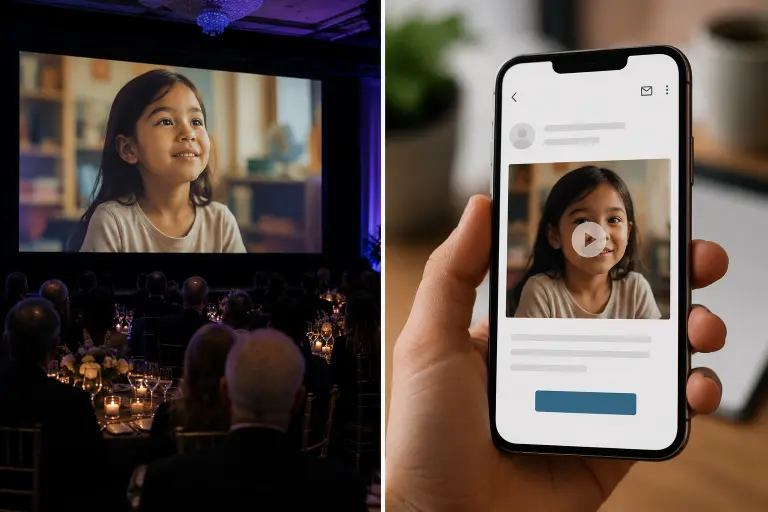
A ballroom is a hostile audio environment. Dialogue that is perfectly clear on headphones disappears under clinking glasses and a low ceiling. Mix gala films louder, with dialogue forward, and never rely on quiet moments landing in a room of four hundred people.
A projected image loses contrast and shadow detail. Footage graded beautifully on a monitor can turn to mud on a ballroom screen. Test the film in the actual venue if at all possible, and build the grade with brighter mids.
Email and social play silently by default. Captions are not an accessibility afterthought here. They are the primary delivery mechanism for the task.
A donation page video needs to load fast and start strong. A donor who arrived intending to give does not need persuading. They need to be reminded why while the page loads.
Producing the same file for all four contexts guarantees it underperforms in at least three of them. Plan the cuts during pre-production, not after.
The Mistakes That Cost Real Gifts
Four errors account for most underperforming fundraising videos, and every one of them is avoidable.
Ending on information instead of emotion. Statistics, logos, and staff credits after the emotional peak actively drain the feeling the film just built. End high.
Making the organization the protagonist. Donors are not moved by your model, your history, or your efficiency ratio. They are moved by a person whose life changed and by their own role in that change.
Burying the ask. A video that mentions giving once, softly, in the middle, has not been asked. The task belongs at the peak, stated plainly, and it should be the last thing the viewer hears.
Running too long. The most common fundraising video failure is a film whose emotional climax arrives after the audience has stopped watching. Cut it, then cut it again.
Fundraising video also works better when it does not carry the whole burden alone. The appeal lands on donors who have been receiving marketing and promotional videos and engagement content all year, which is why organizations that only produce fundraising video consistently underperform.
Test, Then Improve
Fundraising video is one of the few nonprofit assets with clean feedback. Use it.
Run two versions of your appeal video to segments of your email list, differing in the opening ten seconds or in the suggested amount. Watch conversion rate, average gift size, and total raised, not view counts. Note where viewers drop off, because the drop off point is almost always the place the film stopped serving the donor and started serving the organization.
Then keep what worked. A fundraising film that performed well is not disposable. It can be recut, updated, and redeployed for years, and the strongest nonprofits build a library rather than starting over every December.
Fundraising Production in Portland and the Pacific Northwest
Portland's giving landscape is competitive, regionally loyal, and increasingly sophisticated. Donors here see a great deal of nonprofit video, which raises the floor on what earns a gift.
Portland Production Services has produced fundraising videos for Pacific Northwest organizations for more than 20 years, with fully owned equipment and an in-house crew across Portland, Beaverton, Hillsboro, Lake Oswego, Tigard, and Vancouver, WA. For fundraising work specifically, that experience matters at the venue: a team that has run films in these ballrooms knows how the audio behaves, how the screens render, and how a film must hand off to a live task.
Owned gear protects the fundraising calendar. Gala dates and giving days do not move for rental availability, and a crew that controls its own equipment can respond when an emergency appeal cannot wait.
The Film Is Not the Point. The Gift Is.
Fundraising video production is the discipline of building a film that ends in a gift. That means one story, one donor, one amount, one deadline, one action, and an emotional peak timed to arrive exactly when the task does.
Beautiful films that do not close are expensive. Modest films that do are how missions get funded.
Let's Build the Film That Funds Your Year
Portland Production Services has helped Pacific Northwest nonprofits raise money with video for more than 20 years, with owned gear, an in-house crew, and a clear eyed focus on the moment the task lands.
Book a consultation with Portland Production Services and bring your campaign, your calendar, and your goal. We will build the video that closes.
Already worked with PPS? Share your experience in a quick review and help the next nonprofit fund its mission.
Frequently Asked Questions
1.What is fundraising video production?
Fundraising video production is the creation of video engineered to move a specific audience to give a specific amount at a specific moment. Unlike awareness or mission video, its only measure of success is money raised, which shapes the length, structure, and placement of the emotional peak. The film must build feeling and hand off directly to a clear ask.
2.What makes a fundraising video effective?
An effective fundraising video features one person's story, positions the donor as the one making change possible, names a specific gift amount, translates that amount into a concrete outcome, gives a true reason to act now, and closes with one frictionless action. The emotional peak must land exactly when the task arrives. Ending on statistics or logos drains the feeling the film just built.
3.How long should a fundraising video be?
Length depends on the occasion. Gala films run two to three minutes for a captive audience, year end appeal videos perform best at sixty to ninety seconds in an inbox, and capital campaign videos can run longer for donors watching in a boardroom. The most common failure is a film whose emotional climax arrives after viewers have stopped watching.
4.What is the difference between a mission video and a fundraising video?
A mission video explains who your organization is and lives on your homepage year round, while a fundraising video exists to convert a warm supporter into a donor at a defined moment. Repurposing a mission film as an appeal video underperforms because it was built to inform rather than to close. The two require different structures and different endings.
Key Takeaways
- Fundraising video is accountable for money, not understanding, which means the emotional peak must arrive precisely when the task does rather than earlier.
- The task needs five parts: a specific amount, a concrete translation of what it does, a true reason to give now, one frictionless action, and the donor positioned as the agent of change.
- The occasion dictates the film. Gala paddle raise films, year end appeals, giving day cuts, capital campaign videos, major donor films, and emergency appeals each demand different lengths, structures, and production specs.
- Most gifts are lost to friction and to burying the task, not to weak storytelling. PPS brings 20+ years of Pacific Northwest fundraising production, owned gear, and an in-house crew that knows how films land in the room.
There's more ...


Unleash Your Inner Creative Madness With Us!
info@portlandproductionservices.com
503-317-6447
© Portland Production Services 2026
8816 SE 29TH AVE
MILWAUKIE OR 97222-6323, US

