


How Live Streaming Expands the Reach of Corporate and Nonprofit Events
Professional live streaming services protect high-stakes events from audio failures, unstable internet, poor lighting, and stream outages through broadcast-grade production, dedicated engineering, and redundant backup systems designed to keep every live event running cleanly.
Live streaming turns a limited, in-person event into a scalable communication platform. It removes geographic barriers, increases engagement, improves accessibility, and generates content value that outlasts the event itself. But reach alone does not produce results. Professional production quality is what determines whether the virtual audience stays, engages, and acts. This guide covers every dimension of how live streaming for corporate and nonprofit events works when it is executed at a professional level, and why Portland Production Services is the production partner organizations across Portland and the Pacific Northwest trust when the event has to perform for both audiences simultaneously.
Reach Is No Longer Limited by Geography
Physical events come with unavoidable constraints: venue capacity limits participation, travel costs exclude remote stakeholders, and scheduling conflicts reduce attendance for even the most strategically important gatherings.
Live streaming removes those constraints without replacing the in-person experience. Instead of asking who can attend, organizations using professional live streaming can decide who they want to include: remote employees across multiple regions, international partners and stakeholders, donors and supporters outside the immediate community, clients across markets that a physical event could never reach.
For corporate organizations, this means company-wide communications actually reach the company. A town hall that would previously reach the attendees in one office can now be experienced simultaneously by every team member in every location, with the same production quality and the same message.
For nonprofit organizations, this means fundraising galas and impact events can engage the full donor base rather than a subset constrained by geography and ticket availability. A donor watching a live stream from another city can respond to an appeal in real time just as effectively as one seated at a table in the venue.
The expansion happens without adding logistical complexity when the production is properly planned. The infrastructure scales with the audience, not against it.
Hybrid Events Are Now the Standard Expectation
Hybrid events, those that serve both an in-person audience and a simultaneous virtual audience, are no longer a logistical novelty. They are the default expectation for any organization with a distributed workforce, a geographically dispersed donor base, or stakeholders who cannot reliably travel.
The appeal of the hybrid model is clear: in-person experiences can remain focused and high-quality without the cost or capacity constraints of scaling the physical venue to accommodate everyone. Virtual access extends that experience to a wider audience that the venue could never serve.
The challenge is that hybrid only works when the virtual audience feels included rather than secondary. A stream that is clearly an afterthought, with a static wide-angle camera, inconsistent audio, and no production attention to the virtual viewing experience, signals to remote attendees that their participation was not the priority. That signal damages engagement and trust in ways that are difficult to recover.
Professional live streaming production for hybrid events is specifically designed to serve both audiences simultaneously. Camera coverage, audio engineering, lighting, graphics, and pacing are all structured to deliver an experience that reads as intentional to the person in the room and to the person watching on a screen in another city. That simultaneity requires deliberate production planning that starts well before event day.
Engagement Increases When the Stream Is Interactive and Intentional
One of the most persistent misconceptions about live streaming is that it produces a passive viewing experience that cannot match the engagement of physical attendance. In practice, a well-produced live stream often increases participation from audiences who would have stayed quiet in a physical setting.
Modern streaming platforms enable live Q&A sessions where virtual attendees submit questions that are read and addressed in real time. Live chat and moderated discussion give remote participants a way to respond to content as it happens. Audience reaction tools and polling features create feedback loops that make the virtual experience feel participatory rather than observational.
For corporate events, this means employees who might not speak up in a large in-person setting can ask questions, respond to content, and feel heard through the stream interface. For distributed teams, it levels the participation dynamic between those who are physically present and those who are not.
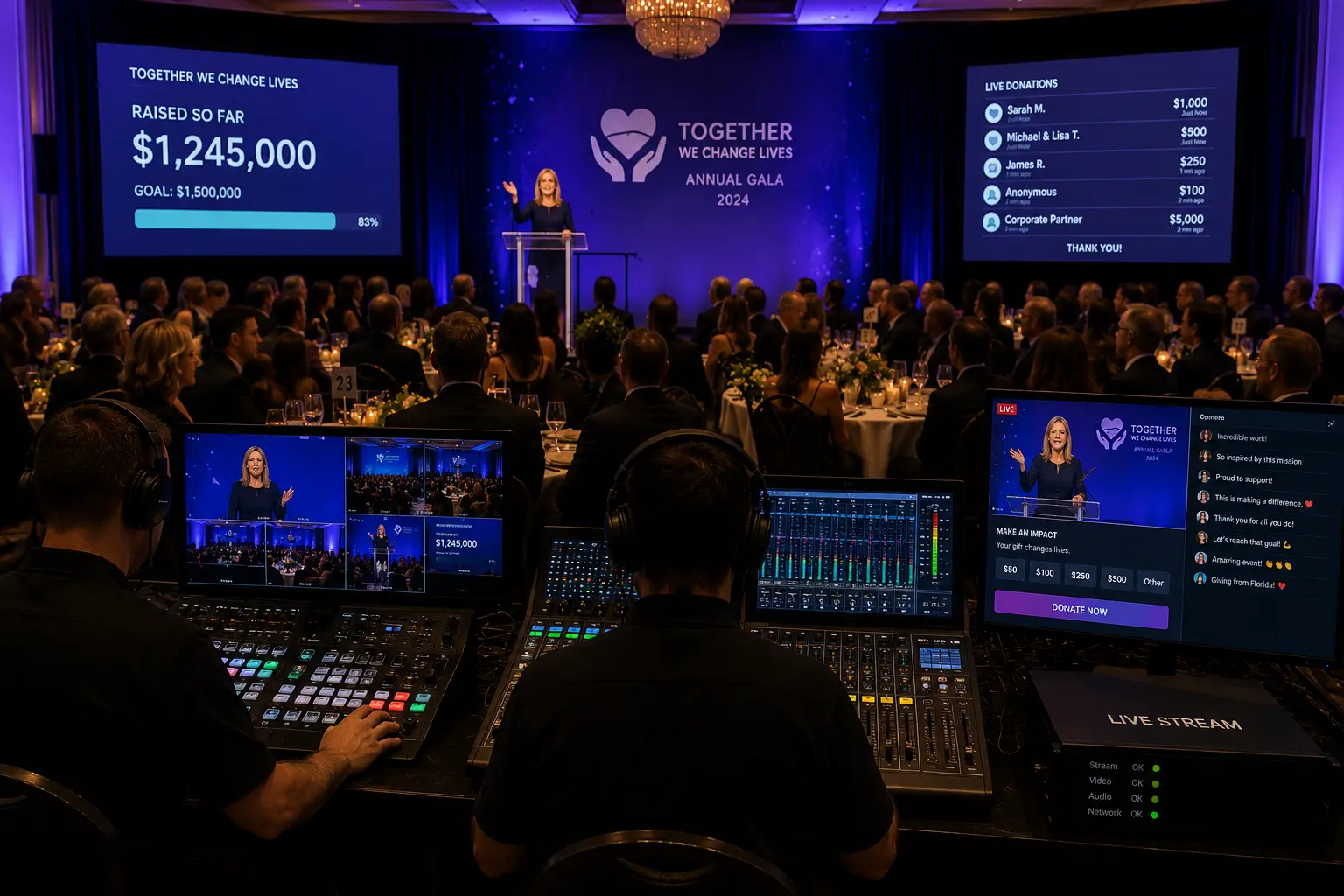
For nonprofit organizations, the stakes are higher and the opportunity is more direct. A well-produced live streaming experience with intentional storytelling and strategically timed donation prompts can convert attention into immediate action in ways that asynchronous content cannot. A compelling testimonial delivered at the right moment in a live gala stream, paired with a real-time donation tracker visible on screen, creates a specific kind of urgency that pre-recorded content cannot replicate.
The distinction is always in the intentionality. When production is structured with audience engagement as a design element rather than a hope, the stream becomes part of the event's impact strategy rather than a documentation afterthought.
Audio Is the Element That Determines Whether Viewers Stay
In every live streaming production, audio is the single most reliable predictor of viewer retention. Not video resolution. Not production polish. Not platform features. Audio.
Viewers will tolerate imperfect visuals. They will not tolerate audio that is difficult to hear, inconsistent, distorted, or clearly unbalanced. The drop-off when audio quality fails in a live stream is immediate and it is permanent for that session.
At large events, audio management is complex because it requires maintaining two entirely separate audio environments simultaneously.
In-room audio is engineered for the physical space: speaker placement, delay timing, room-corrected EQ, and dynamics processing that account for the venue's acoustic behavior, its dead zones, its reflections, and the way the room sounds when it fills with people.
Stream audio is engineered for headphone and laptop speaker playback: a dedicated mix with different EQ, different dynamics processing, and different level management that compensates for the absence of the physical acoustic environment that makes in-room audio intelligible. The EQ that makes in-room audio sound natural actively makes stream audio sound worse when applied without modification.
From Portland Production Services' production experience: the moment in-room audio and stream audio are treated as a single system, stream quality suffers for every virtual attendee. Building and managing two separate mixes simultaneously is not a premium option in professional live streaming production. It is the baseline operational requirement.
Wireless microphone coordination, music copyright management for platform compliance, and synchronized delay timing across multiple speakers are all additional audio engineering requirements that large-scale live streaming introduces and that professional production teams manage as standard practice.
Visual Quality Shapes Credibility Before the First Word Is Spoken
The visual impression a live stream makes on the viewer begins before any content is communicated. Audiences form assessments of production quality, organizational professionalism, and content credibility within seconds of the broadcast beginning.
Venue house lighting, designed for in-person visibility rather than camera output, creates predictable problems on screen: overexposed or underlit faces, inconsistent color temperatures, heavy shadows that make presenters look unflattering or difficult to read as engaged and authoritative. These visual signals communicate something to the viewer about the organization behind the event before a single word of the program has been delivered.
Professional lighting for live streaming is calibrated specifically for camera output: consistent color temperature across all lighting sources, key and fill lighting that renders subjects naturally and credibly, and visual consistency throughout the event regardless of program transitions or ambient light changes.
For corporate brands, visual quality reinforces organizational professionalism directly. For nonprofit organizations, it shapes how the audience receives the emotional storytelling that fundraising depends on. A tribute video presented on a poorly lit stage with an inconsistent camera feed undermines the impact of the content itself. The same content on a well-lit, polished broadcast lands with the full weight it was designed to carry.
Live Streams Create Content Value That Outlasts the Event
One of the most consistently underutilized advantages of live streaming is the content that becomes available immediately after the broadcast ends.
A professionally produced live stream is not just the broadcast. It is source material. The same production session that delivers the live experience also captures footage that can be structured into on-demand replays for audiences who could not watch live, short-form social media clips from key moments, internal training materials from educational sessions, marketing assets built around compelling program highlights, and supporting content for future campaigns or communications.
For nonprofit organizations, event footage becomes donor stewardship content, grant documentation, and community storytelling material that extends the reach of the event's impact message for months after the broadcast date.
For corporate organizations, sessions captured at a live event become part of the internal communication library: onboarding content, training modules, and leadership communication assets that continue serving the organization long after the production budget has been returned as content value.
A single professionally produced live streaming engagement, planned with repurposing in mind from the start, can generate content that functions across every channel and every audience segment the organization needs to serve.
Accessibility Is an Organizational Signal, Not Just a Feature
Live streaming enables organizations to include audiences who are excluded from physical events by mobility or health limitations, financial constraints that make travel or ticket costs prohibitive, and scheduling conflicts that cannot accommodate in-person attendance.
Professional production setups support captioning, multiple language options, and optimized visual clarity for remote viewing, all of which extend meaningful access rather than nominal access.
This matters not just as an operational practice but as an organizational signal. The audiences who benefit from accessible live streaming are paying attention to whether the organization made genuine efforts to include them or added accessibility as an afterthought. That distinction shapes loyalty, trust, and long-term engagement in ways that are difficult to quantify but consistent in their effect.
Reliability Is What Keeps Audiences Coming Back
Live streaming offers no opportunity for second chances. A technical failure during a high-stakes moment does not just disrupt the event. It creates a lasting impression about the organization's competence and care for its audience.
Professional production teams protect against this through deliberate redundancy planning: backup internet connections that maintain stream continuity if the primary connection degrades, redundant audio feeds from primary microphone sources, secondary recording systems independent from the live stream, failover encoding hardware, and active monitoring throughout the event.
The standard is not preventing problems, because problems will occur. The standard is ensuring that problems never reach the audience. When redundancy is properly built into the production plan, the stream continues cleanly while the technical issue is resolved behind the scenes.
Reliability builds the trust that makes audiences return for the next event, recommend the organization to their networks, and associate the brand with the competence the broadcast communicated.
For Nonprofits: Live Streaming as a Fundraising Engine
For nonprofit organizations, live streaming is not just an audience reach strategy. It is a fundraising tool with direct revenue implications when it is used intentionally.
A professionally produced nonprofit gala stream can integrate real-time donation tracking visible to both the in-room and virtual audiences simultaneously, creating social proof dynamics where visible participation encourages additional participation. Live testimonials from beneficiaries, board members, or high-profile supporters delivered directly into the stream at strategically timed moments convert audience attention into immediate action. Sponsor visibility and recognition integrated into the broadcast extends the value of sponsorships to a virtual audience that multiplies the brand exposure the sponsor paid for.
The distinction between a nonprofit live stream that drives donations and one that does not is almost entirely in the production planning. When the stream is designed as a fundraising tool from the beginning, with story placement, timing, and interactive elements all structured around the campaign objective, it performs as one. When it is treated as a documentation service, it documents the event without influencing its outcomes.
Why Local Production Expertise Matters
Working with a production team that has direct experience in the venues, infrastructure environments, and event landscapes of Portland and the Pacific Northwest provides practical advantages that general production expertise cannot replicate.
Venue-specific knowledge means faster assessment of power constraints, acoustic challenges, and load-in logistics that would otherwise require on-site discovery during setup. Regional familiarity with RF environments in specific venues and districts reduces the frequency planning work required to ensure wireless microphone reliability. Established relationships with venue technical staff accelerate the coordination that determines whether setup runs smoothly or encounters unexpected friction.
Portland Production Services brings both the technical production capability and the local operational familiarity that reduce risk at every stage of the event, from the initial venue assessment through the final post-event strike.
Live Streaming and Event Production Services
Below outlines what Portland Production Services delivers for corporate and nonprofit live streaming and related event production.
Event Production and Live Streaming- Full broadcast-grade live streaming with multi-camera, dedicated audio, lighting, graphics, and redundancy. Corporate conferences, nonprofit galas, commencement ceremonies, fundraisers, hybrid events
Nonprofit Storytelling- Mission-driven video content for integration into live streams and post-event distribution. Nonprofit organizations producing annual events and fundraising campaigns
Commercial Video Production- Branded pre-produced video packages for display during live events and post-event marketing. Organizations incorporating campaign content into live-streamed event programming
Marketing and Promotional Videos- Event recap and highlight content produced from live event footage for sustained marketing use. Brands and nonprofits extending the reach of their events beyond the broadcast date
Corporate and Training Videos- Recorded session content from live events repurposed for internal training and communication. Companies capturing knowledge and leadership content from live events for ongoing use

Live Streaming Is a Strategic Discipline, Not a Broadcast Feature
Live streaming for corporate and nonprofit events is not a feature that organizations add to events. It is a strategic discipline that determines how far an event's message travels, how deeply it engages the audience it reaches, and how long it continues generating value after the broadcast ends.
When audio is engineered for two separate environments simultaneously. When lighting is calibrated for camera output. When redundancy is built into every critical system. When interactive elements are designed to drive specific audience behaviors. When repurposing is planned before the production begins. That is when live streaming stops being a documentation service and starts functioning as one of the most powerful communication tools an organization can deploy.
Portland Production Services brings twenty-plus years of live event production experience, fully owned equipment, and a team-based production approach to every corporate and nonprofit live streaming engagement across Portland and the Pacific Northwest.
Ready to Turn Your Next Event Into a Platform That Reaches Everyone Who Matters?
Your message deserves an audience as large as the impact you are trying to create. Portland Production Services brings professional live streaming production to corporate and nonprofit events across Portland and the Pacific Northwest. Tell us about your event and we will show you exactly how to build a broadcast that performs for everyone watching.
Frequently Ask Questions
1: Is live streaming worth it for smaller corporate or nonprofit events?
Yes. Even smaller events benefit from extended reach and the content value that a professionally produced live stream generates. The production scale adjusts to the event's scope and goals, but the strategic advantages of geographic reach, content repurposing, and accessibility apply at any event size. The key is aligning production investment with the specific outcomes the event needs to achieve.
2: What matters more for live streaming: video quality or audio quality?
Audio quality is the more critical variable for viewer retention in any live streaming production. Viewers will tolerate lower video resolution but will abandon a stream with poor audio almost immediately. This is especially true for corporate events where clarity of communication is the primary objective and for nonprofit events where emotional storytelling depends on the audience hearing every word clearly.
3: How can live streaming increase nonprofit fundraising outcomes?
A professionally produced live streaming experience for nonprofit events integrates real-time donation tracking visible to both in-room and virtual audiences, strategically timed testimonials and impact stories, and live donation prompts at moments of peak emotional engagement. These elements create urgency and social proof that convert audience attention into immediate action in ways that pre-recorded content cannot replicate. The production structure determines whether the stream functions as a fundraising tool or only as documentation.
4: How do you keep virtual attendees engaged during a live-streamed corporate event?
Engagement for virtual attendees in a live streaming environment is maintained through structured production: multiple camera angles that keep the visual experience dynamic, interactive elements like live Q&A and moderated chat that give remote attendees a way to participate, clear pacing with intentional transitions between program segments, and graphics that provide context and reinforce the event's messaging. These are production decisions, not platform features, and they require deliberate planning before the event.
5: What is the difference between in-room audio and stream audio for live events?
In-room audio is engineered for the acoustic environment of the physical venue: speaker placement, delay timing, and EQ corrections that account for the room's specific behavior. Stream audio requires a completely separate mix engineered for headphone and laptop speaker playback, without relying on the room environment that makes in-room audio intelligible. The EQ and processing that make in-room audio sound natural make live streaming audio sound worse when applied without modification. Professional production teams manage both simultaneously as independent systems.
6: How does Portland Production Services approach live streaming for corporate and nonprofit events?
Portland Production Services treats every live streaming engagement as a full broadcast production: separate in-room and stream audio mixes, professional lighting calibrated for camera output, multi-camera coverage with live switching, graphics and lower thirds, cloud-based encoding with cellular backup, real-time monitoring, and redundant systems throughout. For nonprofit events, the production structure is specifically designed to support fundraising objectives with strategic story placement and interactive donation integration. For corporate events, it is designed to deliver equal production quality to in-room and virtual audiences simultaneously.
Key Takeaways
- Live streaming removes geographic constraints and turns single events into scalable communication platforms that reach every audience an organization needs to serve, regardless of location or availability.
- Hybrid events, those serving both in-person and virtual audiences simultaneously, require production specifically designed for both. Virtual attendees who feel secondary to the in-room experience disengage immediately.
- Audio is the most critical element of any live streaming production, and in-room audio and stream audio must be managed as two completely separate engineering environments. Treating them as a single system compromises stream quality for every virtual attendee.
- Interactive production elements, live Q&A, moderated chat, real-time donation tracking, and strategic story placement, are what determine whether a live stream drives audience behavior or only documents the event.
- Portland Production Services delivers broadcast-grade live streaming production for corporate and nonprofit events across Portland and the Pacific Northwest, with owned equipment, local venue expertise, and twenty-plus years of live event production experience.
There's more ...
.webp)
.webp)
Unleash Your Inner Creative Madness With Us!
info@portlandproductionservices.com
503-317-6447
© Portland Production Services 2026
8816 SE 29TH AVE
MILWAUKIE OR 97222-6323, US

