


How to Live Stream a Large Event Without Technical Issues
Live streaming a large event requires more than a camera and internet connection. Professional production depends on multi-camera coverage, dedicated audio engineering, stable internet infrastructure, redundancy systems, and coordinated technical planning to deliver a seamless broadcast experience without interruptions.
Live streaming a large event requires full production planning across audio, video, internet infrastructure, lighting, stage design, and coordination. What works for a small meeting falls apart at scale. This guide covers every technical and logistical element that determines whether a large-scale live stream delivers a seamless experience or becomes a visible production failure in front of a live audience. When you need a professional live streaming team for your next Portland or Pacific Northwest event, Portland Production Services handles the full production so the stream runs clean from the first frame to the final close.
Live Streaming Is a Full Production, Not a Technical Add-On
The most common and most expensive misconception about live streaming a large event is that it only requires a camera and an internet connection. This assumption is what turns large-scale streams into visible failures.
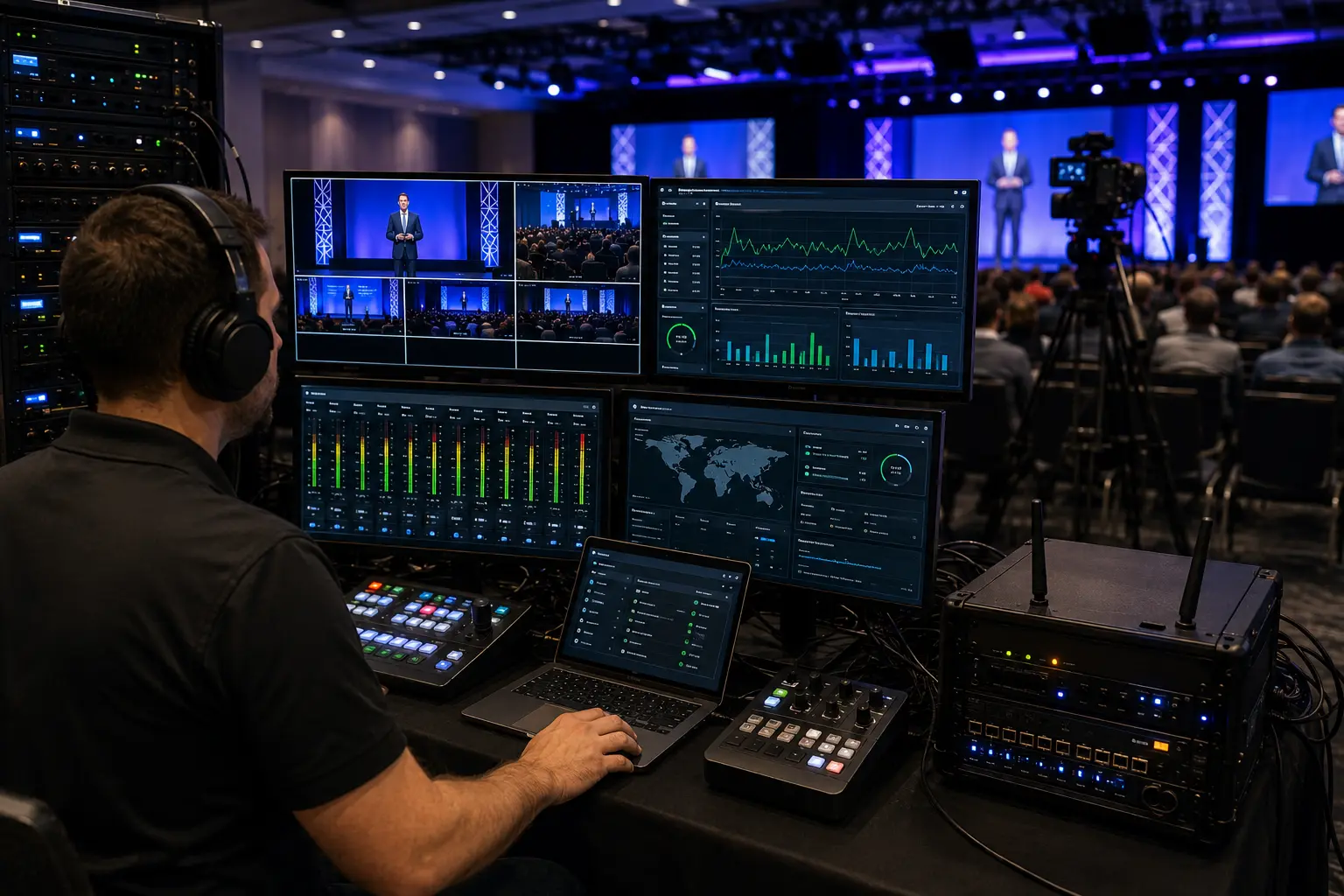
Professional live streaming at scale operates as a broadcast environment. It is not a recording. It is a real-time transmission system with multiple interdependent components, each one capable of affecting the quality and continuity of the entire output if it fails or is improperly configured.
A complete large-scale live streaming production includes:
- Multiple cameras capturing different perspectives simultaneously
- A live switcher managing real-time cuts between angles to create a dynamic viewing experience
- Dedicated audio feeds engineered specifically for the stream, not repurposed from the in-room PA
- Encoding hardware or software that compresses and transmits the signal to the streaming platform
- Redundant backup systems for every critical component that cannot fail live
When any of these elements is overlooked, the effect is not contained. It propagates through the entire stream. Audio failure means the virtual audience hears nothing. Encoding failure means the stream goes offline. Camera failure means the production collapses to a single angle or goes dark. Planning for each element individually and for their interaction collectively is what professional live streaming production actually requires.
Define the Goals Before Making Any Technical Decisions
The technical requirements for live streaming a large event vary significantly based on what the stream is designed to accomplish. Defining those goals before any equipment or platform decisions are made shapes every subsequent choice.
A stream designed for internal company communication has different requirements than one intended for public broadcast. A stream that will be recorded and repurposed as marketing content needs different post-production planning than one that exists only in real time. A stream with interactive Q&A and audience participation features requires different platform capabilities than a passive broadcast.
Common live streaming objectives and their production implications:
Reaching remote audiences who cannot attend in person requires reliable delivery infrastructure, stable encoding, and a platform capable of handling the expected viewer load.
Recording content for future use requires local recording as a separate workflow from the live stream itself, ensuring that platform outages do not result in lost footage.
Delivering a polished broadcast experience requires multi-camera production, live switching, professional graphics, and stream monitoring throughout the event.
Supporting interactive features like live Q&A or audience polling requires platform selection and production workflow that accommodate those inputs without disrupting the main stream.
Aligning the production plan with the goals before the technical design is built prevents the most common category of large-event live streaming problems: systems that are correctly configured for the wrong objective.
Audio: The Element That Determines Whether Viewers Stay
In any live stream, audio quality is the single most reliable predictor of viewer retention. Not video resolution. Not production polish. Audio.
Viewers will watch a lower-resolution stream with clear audio. They will abandon a high-resolution stream with distorted, muffled, or inconsistent audio within seconds of the problem appearing. Large events amplify this challenge because they introduce multiple simultaneous audio sources that each need to be managed, balanced, and delivered to the stream independently of how they are handled for the in-room audience.
Large event live streaming audio sources typically include:
- Keynote speakers and panelists on wireless microphones
- Live performances or musical elements
- Video playback audio from presentations and pre-produced content
- Audience interaction moments
The critical distinction for live streaming is that in-room audio and stream audio are not the same signal. What sounds balanced in a large ballroom, where the room's acoustics, reflections, and the physical presence of a sound system all contribute to the experience, does not automatically translate to a listener on headphones or laptop speakers. Professional audio engineering for live streaming creates a separate, optimized feed specifically for the stream rather than splitting the signal from the in-room PA.
Key audio requirements for live streaming large events:
Dedicated stream mix: A separate audio mix engineered for headphone and speaker playback rather than large-venue PA output.
Wireless microphone coordination: In large venues, wireless frequency management is a technical requirement, not a preference. Convention centers, university campuses, and downtown event venues may have multiple wireless systems operating in the same frequency space. Frequency planning prevents interference that would otherwise appear as dropouts, distortion, or noise on the stream.
Licensed or cleared music: Popular music played at the event cannot always be included in the live stream without triggering automated content detection on platforms like YouTube and Facebook. This is one of the most frequently overlooked issues in large event live streaming and one of the easiest to address with advance planning.
Backup audio feeds: A redundant feed ensures that a microphone failure or console issue does not silence the stream without a recovery path.
Internet Infrastructure: The Foundation the Stream Runs On
No element of a large event live stream fails more publicly or more completely than internet connectivity. A stream that drops mid-keynote cannot be quietly recovered. The virtual audience sees it immediately and the event's professional reputation takes the hit.
Large event live streaming requires dedicated, stable internet infrastructure that is isolated from the general venue network. Shared Wi-Fi used by hundreds of guests in the same space is not a foundation for a professional stream. It is a bandwidth competition that the stream will lose when the room fills up.
What professional live streaming internet infrastructure requires:
Hardwired dedicated connection: An ethernet connection on a circuit that is not shared with guest Wi-Fi, venue administrative systems, or any other competing traffic.
Sufficient upload bandwidth: Upload bandwidth requirements depend on stream resolution, encoding settings, and whether redundant streams are being sent simultaneously. This should be calculated based on the actual technical requirements of the production, not estimated.
Real-time monitoring: Upload speed and connection stability should be monitored actively throughout the event. Bandwidth degradation that occurs mid-event requires immediate detection and response before it affects stream quality.
Cellular bonding as backup: When venue internet is insufficient or unreliable, cellular bonding devices aggregate multiple mobile connections into a single reliable stream path. Portland Production Services uses cloud-based encoding that maintains stream stability even when primary venue internet is inconsistent, with cellular bonding as a redundant backup path.
Network isolation from guest traffic: Even on a dedicated circuit, guest device traffic can affect available bandwidth in shared network environments. Confirming true network isolation before the event begins is the operational standard, not an assumption.
Camera Coverage and Live Switching
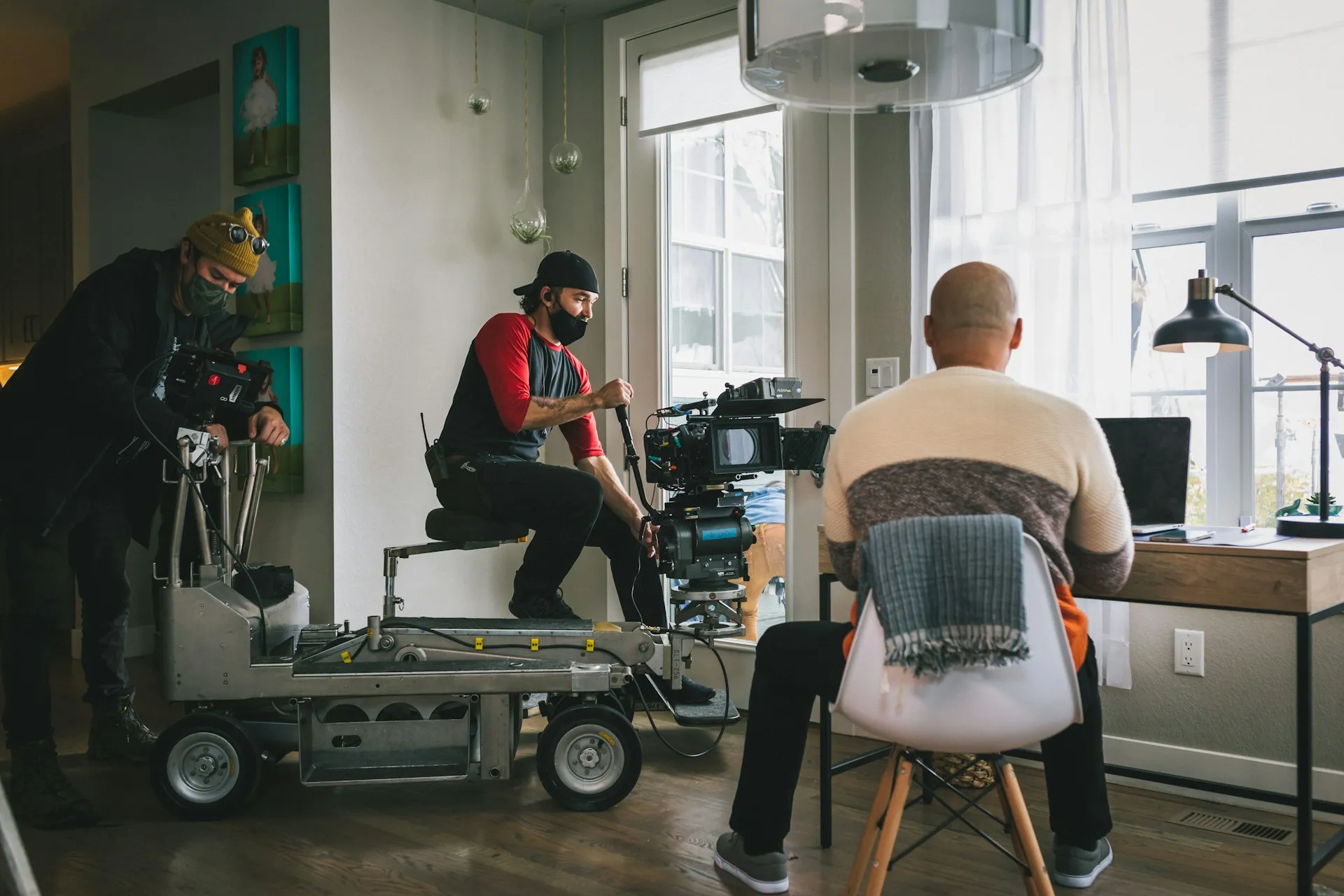
A single locked-off camera at the back of the room is not a professional large event live stream. It is a recording. The distinction matters to every virtual attendee who is trying to feel present in an event they cannot physically attend.
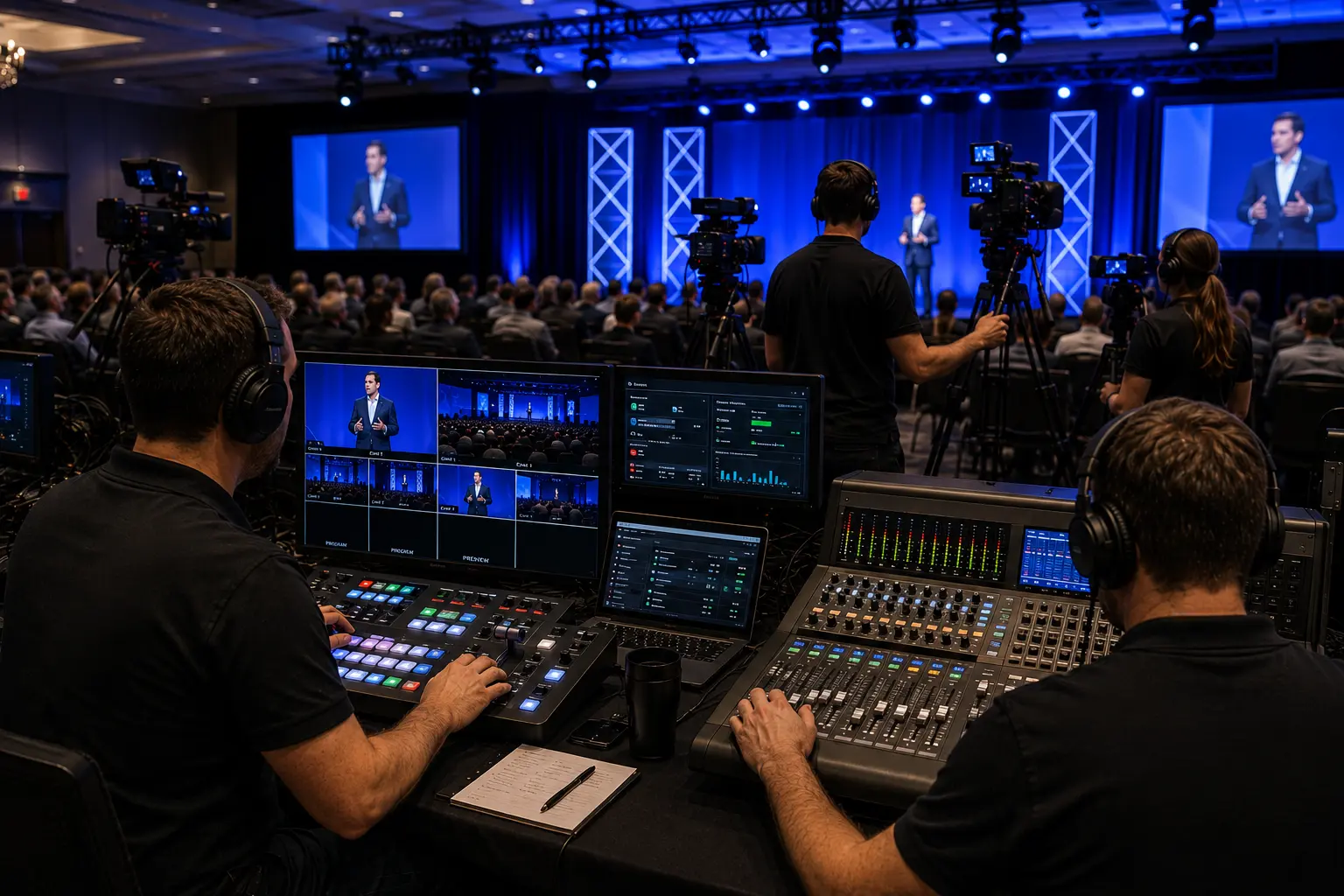
Multi-camera production for large event live streaming typically includes:
A wide stage shot that establishes spatial context and covers processionals, group moments, and full-stage activity.
A podium or presenter camera that holds on whoever is speaking, capturing the facial expressions, gestures, and direct communication that make a speaker feel present to the virtual audience.
A crowd or audience camera that captures reaction moments, applause, and the human energy of the room that virtual attendees are missing by not being there.
A safety or backup camera that provides a fallback angle if any primary camera encounters a technical issue or a blocked sight line.
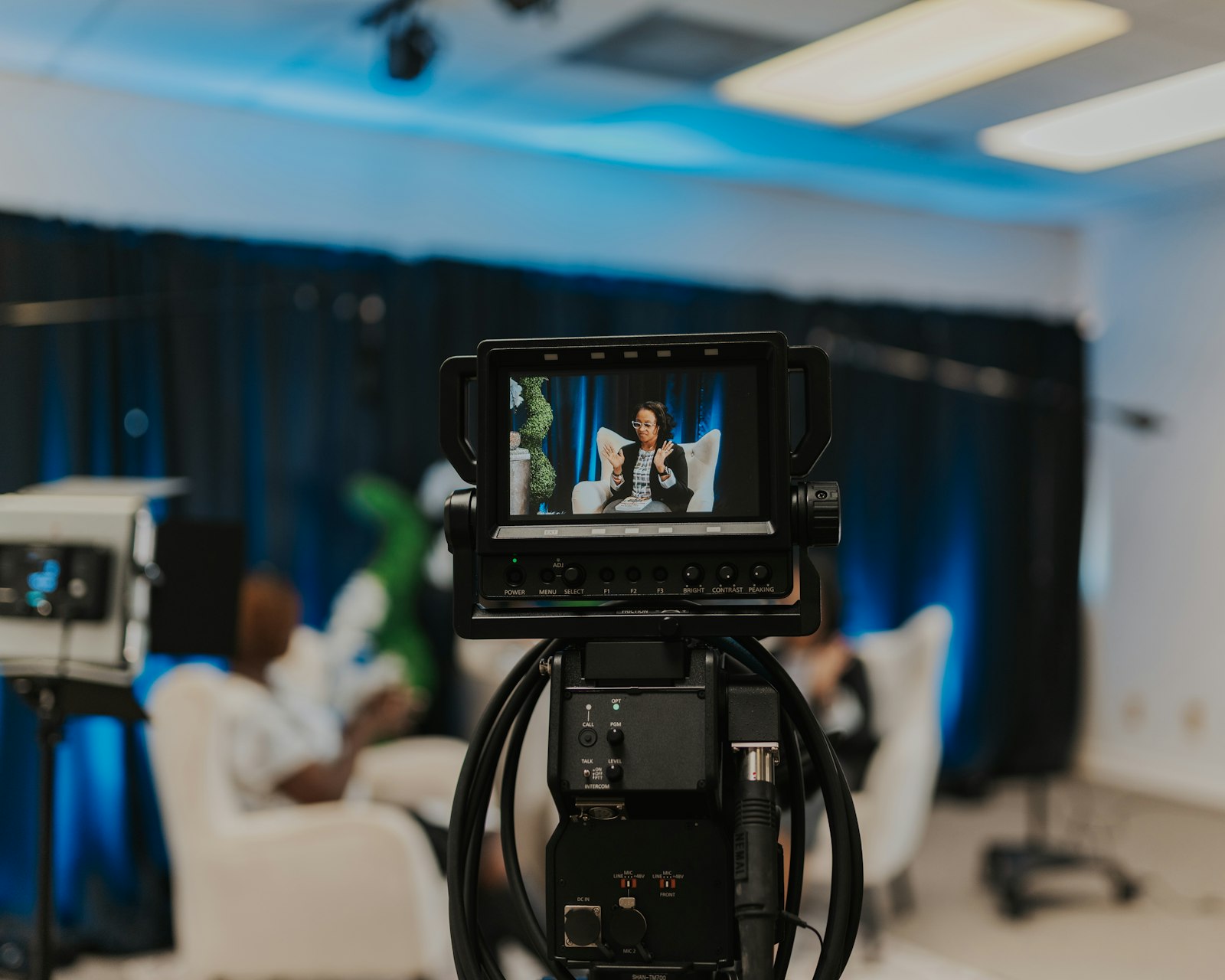
Live switching is the technical discipline that connects these cameras into a coherent viewing experience. A technical director managing the switcher in real time makes the cuts that keep the stream visually dynamic and editorially intentional. Without live switching, a multi-camera setup produces multiple simultaneous feeds. With it, it produces a broadcast.
Lighting Designed for Cameras, Not Just the Room
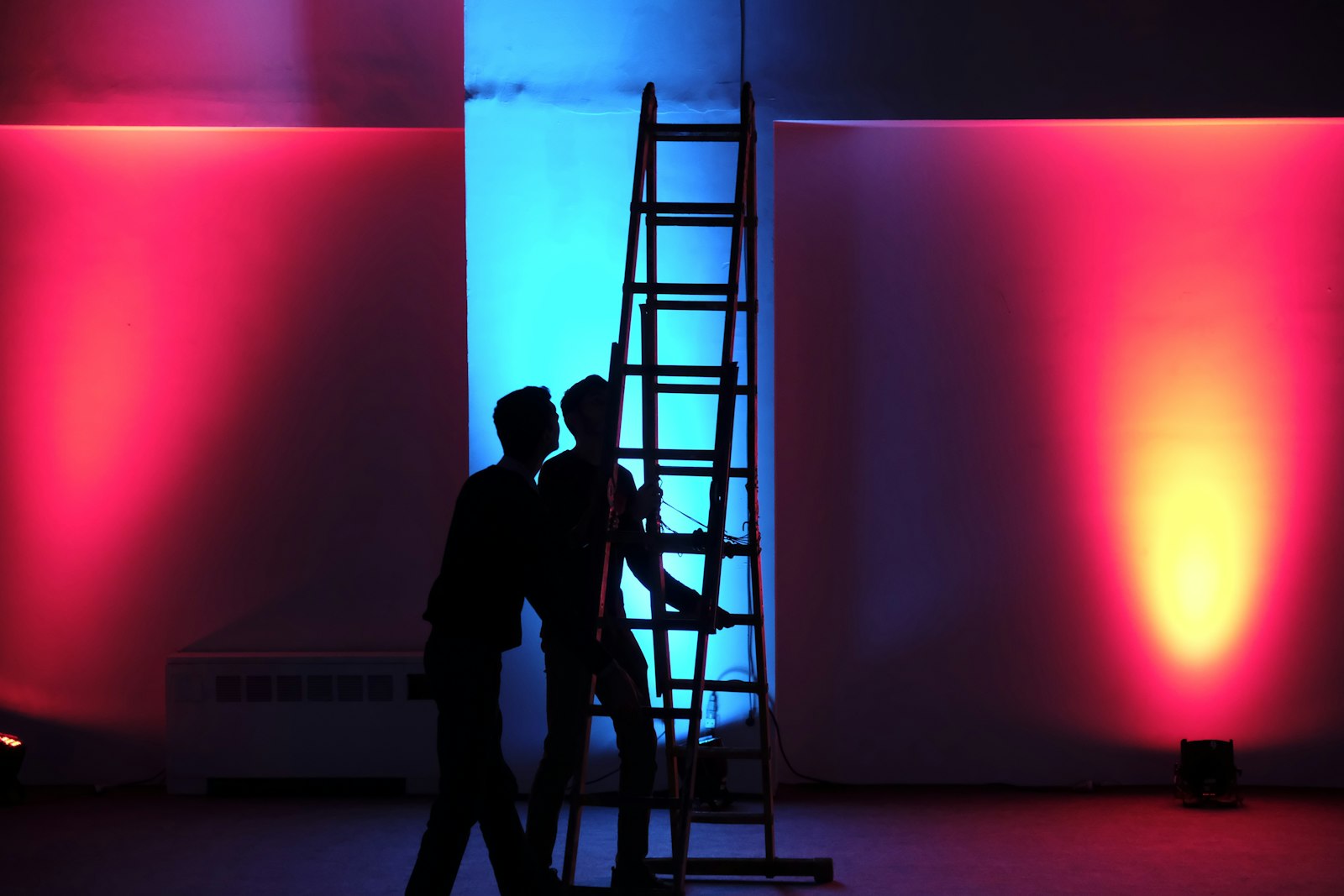
Venue lighting designed for in-person audiences does not automatically serve the needs of a live camera feed. Cameras respond to light differently than the human eye, particularly with respect to color temperature, contrast, and the behavior of bright and dark areas within the same frame.
A presenter standing in house lighting that looks perfectly appropriate to the in-person audience may appear overexposed, oddly colored, or poorly defined on camera. Professional lighting design for live streaming addresses this by evaluating lighting specifically through the camera's perspective, not just the room's.
Key lighting considerations for large event live streams:
Stage lighting calibrated for cameras: Presenters need to be clearly visible on camera with natural skin tone rendering and sufficient contrast to read as present and engaged rather than washed out or underlit.
Consistency throughout the event: Lighting changes that look intentional and atmospheric to the in-room audience can create jarring, disorienting transitions in the video feed if they are not designed with the stream in mind.
Color temperature management: Mixing warm and cool light sources in the same frame creates color inconsistencies that affect how professional the stream looks. Color-consistent lighting design prevents this.
Separation of lighting and audio power: Dimmer-controlled lighting systems can introduce electrical interference in audio equipment if they share power circuits. Separating these systems is a standard professional precaution.
Power Planning for Live Streaming Production
Power is one of the most consistently underestimated elements in large event live streaming, and failures at the power level affect every other system simultaneously.
A complete large event live streaming production draws power across cameras, lighting systems, audio consoles, wireless microphone transmitters and receivers, encoding hardware, networking equipment, monitoring displays, and any backup systems running in parallel. The cumulative power requirement is substantial and must be planned against the venue's actual available circuit capacity, not its theoretical maximum.
Dedicated circuits for production equipment prevent the competition for available amperage that causes brownouts, equipment resets, and the kind of intermittent failures that are difficult to diagnose in real time under event conditions.
Separation of audio and lighting power prevents the interference that dimmer-controlled lighting systems introduce into audio signal chains when they share electrical infrastructure.
Backup power planning for encoding hardware and streaming equipment ensures that a facility power interruption does not take the stream offline permanently. For mission-critical streams, uninterruptible power supplies on encoding and networking equipment provide bridge time to respond to a power event before the stream is affected.
Redundancy: The Standard That Separates Professional Production
At large events, technical issues are not a question of whether they will occur. They are a question of whether they will be visible to the audience when they do. The answer to that question is determined entirely by how thoroughly redundancy is built into the production plan.
What professional redundancy looks like in large event live streaming:
- Backup cameras for critical angles
- Redundant audio feeds from all primary microphone sources
- Backup encoding hardware or cloud encoding failover
- Primary and backup internet connectivity paths
- Local recording as an independent system from the live stream
- Backup power for critical equipment
Every component that cannot fail during the event needs a backup that can take over without the audience noticing the transition. This is not a premium option in professional live streaming production. It is the baseline operational standard.
Choosing the Right Streaming Platform
Platform selection for live streaming a large event should be driven by the audience's access requirements, the event's privacy needs, the expected viewer volume, and the interactive features the program requires.
YouTube offers broad accessibility, strong search discoverability, and scheduling tools that allow event links to be distributed in advance. It is the most commonly used platform for public-facing large event streams and handles significant viewer volumes reliably.
Private or password-protected platforms are appropriate for internal corporate streams, board meetings, and events where controlled audience access is required.
Interactive platforms with built-in Q&A, polling, and audience participation tools are appropriate for conferences and educational events where real-time audience engagement is part of the program.
Simultaneous multi-platform streaming is possible with encoding hardware or software that can distribute a single stream to multiple destinations simultaneously, extending reach without requiring separate production setups.
Platform selection should happen early in the planning process because it affects encoding specifications, graphics requirements, and how the event is promoted to virtual attendees.
Graphics and Production Polish
Professional live streaming graphics are one of the most visible differentiators between a broadcast-quality stream and a raw camera feed. Lower thirds identifying speakers, intro and outro sequences, transition graphics between program segments, and branded visual overlays all contribute to a viewing experience that signals professionalism to the virtual audience.
From Portland Production Services' production experience, graphics are consistently one of the elements that clients underestimate in the planning phase and notice most clearly in the comparison between polished productions and basic ones. A stream with professional graphics communicates that the organization invested in the virtual audience's experience, not just the in-room one.
Coordination: What Makes Everything Work Together
Live streaming a large event involves multiple teams operating in the same space under time pressure with shared dependencies. Audio engineers, camera operators, a technical director, a streaming engineer, lighting designers, stage managers, and venue staff all need to coordinate without any of that coordination becoming visible to the audience.
The infrastructure that makes this work is a shared, detailed production plan: a run of show that every team member has reviewed, a rehearsal that tests every technical system under realistic conditions before the event goes live, and clear communication protocols that allow problems to be identified and resolved quietly rather than publicly.
Portland Production Services approaches every large event live stream as a unified production rather than a collection of independently operating technical services. The result is a stream where every element from audio to graphics to camera switching responds to the same production plan, in real time, throughout the event.
Live Event Streaming and Production Services
Below outlines what Portland Production Services delivers for large event live streaming and related production services.
Event Production and Live Streaming- Full broadcast-grade live streaming with multi-camera, audio, graphics, and redundancy
Corporate conferences, galas, commencement ceremonies, product launches
Commercial Video Production- Pre-produced video content for display during live events and post-event distribution
Organizations integrating video packages into live event programming
Corporate and Training Videos- Event recap and highlight content produced from live event footage
Brands turning one-time events into sustained marketing content
Marketing and Promotional Videos- Recorded session content from live events repurposed for internal use
Companies capturing training and communication content at live events
Nonprofit Storytelling- Live-streamed galas, fundraisers, and impact events for donor and supporter audiences
Nonprofit organizations producing annual events and fundraising programs
Live Streaming at Scale Requires Production at Scale
Live streaming a large event is not a technology problem. It is a production problem. The technology is available to any team with access to the right equipment. What separates streams that run cleanly from ones that encounter visible failures is the experience, preparation, and redundancy discipline that a professional production team brings to every element of the system.
When audio, video, internet infrastructure, power, lighting, graphics, and coordination are all planned with the same level of attention, the virtual audience experiences the event the way it was designed to be experienced. Portland Production Services brings twenty-plus years of live event production experience to every large-scale stream, with owned equipment, redundant systems, and a team built for the complexity that large events actually require.
Ready to Plan a Large Event Live Stream That Runs Without Issues?
Your virtual audience deserves the same production quality as everyone in the room. Portland Production Services handles the full live streaming production for large events in Portland and across the Pacific Northwest. Tell us about your event and we will show you exactly how to build a stream that performs.
Frequently Ask Questions
1: What does live streaming a large event actually require?
Live streaming a large event requires a complete broadcast-grade production system: multiple cameras with a technical director managing live switching, a dedicated audio mix engineered for stream delivery, professional encoding hardware, dedicated internet infrastructure isolated from guest traffic, redundant backup systems for every critical component, and professional lighting calibrated for camera output. The complexity scales with the event, and what works for a small meeting is insufficient for a large production.
2: Why does audio matter more than video in a live stream?
Viewers will watch a lower-quality video stream with clear audio. They will abandon a high-quality video stream with poor audio within seconds. In large event live streaming, audio is also the most technically complex element because it involves multiple simultaneous sources, a separate mix from the in-room PA, wireless frequency management in busy RF environments, and music licensing considerations that can trigger automated platform interventions if not addressed in advance.
3: How do you ensure internet stability for a large event live stream?
Reliable internet for live streaming a large event requires a hardwired dedicated connection on a circuit isolated from guest traffic, upload bandwidth calculated against actual encoding requirements, real-time monitoring throughout the event, and cellular bonding as a backup connectivity path. Shared venue Wi-Fi is not sufficient infrastructure for a professional large event stream.
4: What is redundancy in live streaming and why is it essential?
Redundancy means having a backup system ready for every critical component that cannot fail during the event. Backup cameras, redundant audio feeds, backup encoding hardware or cloud failover, dual internet connectivity paths, and local recording independent from the live stream are all standard redundancy measures in professional large event live streaming. When a component fails, the backup takes over without the audience noticing.
5: How early should live streaming production planning begin for a large event?
For large events, live streaming production planning should begin at least six to eight weeks before the event. Venue power assessment, internet infrastructure coordination, platform selection, graphics development, rehearsal scheduling, and crew coordination all require lead time that is not available in the final weeks before the event. The most preventable large event live streaming failures are the ones that result from planning that starts too late.
6: How does Portland Production Services approach large event live streaming?
Portland Production Services treats every large event live stream as a full broadcast production: multi-camera setup with live switching, dedicated audio engineering for the stream feed, professional graphics and lower thirds, cloud-based encoding with cellular bonding backup, real-time monitoring throughout the event, and redundant systems for every critical component. The team has produced large-scale live-streamed events across Portland and the Pacific Northwest for over twenty years, with owned equipment and a production structure built for the complexity these events require.
Key Takeaways
- Live streaming a large event is a full broadcast production, not a camera-and-connection setup. Every element, audio, video, internet, power, lighting, graphics, and coordination, requires deliberate planning.
- Audio is the element most directly responsible for viewer retention and the most technically demanding to execute correctly at large event scale. A dedicated stream mix, wireless frequency management, and licensed music planning are all non-negotiable.
- Dedicated, hardwired internet infrastructure isolated from guest traffic is the minimum connectivity standard for a professional large event live stream. Cellular bonding as a backup path protects against venue connection failures.
- Redundancy at every critical system level is what separates streams that run cleanly from those that encounter visible failures. If a component cannot fail live, it needs a backup that can take over invisibly.
- Portland Production Services delivers full broadcast-grade live streaming production for large events in Portland and across the Pacific Northwest, with owned equipment,
There's more ...



Unleash Your Inner Creative Madness With Us!
info@portlandproductionservices.com
503-317-6447
© Portland Production Services 2026
8816 SE 29TH AVE
MILWAUKIE OR 97222-6323, US

