




Donor Testimonial Videos for Nonprofits: How to Build Trust and Inspire More Giving
Discover how donor testimonial videos build credibility, strengthen donor trust, and encourage more people to support your nonprofit mission.
Nonprofits spend enormous energy proving their impact to donors and comparatively none letting donors prove it to each other. That is a strange allocation, because the single most persuasive voice in fundraising is not the executive director, the beneficiary, or the annual report. It is a person very much like the prospect, explaining why they decided to give.
Donor testimonial videos work on a mechanism nothing else in your communications toolkit can access: peer trust. A prospect discounts what your organization says about itself and discounts, slightly, what a beneficiary says on your behalf. What they cannot easily discount is someone with nothing to gain saying they investigated, they gave, and they would do it again. This guide covers how to make that video well, a specialized corner of nonprofit video production most organizations never attempt.
Why Donor Testimonials Work Differently Than Beneficiary Stories
Both are essential and they persuade through entirely different pathways.
A beneficiary story creates empathy. The viewer feels something for a person whose life your work touched, and that feeling opens the door to giving. It is the emotional engine of nonprofit fundraising, and nothing replaces it.
A donor testimonial creates permission. The prospect is not asking whether your cause matters. They already suspect it does. They are asking whether giving to you specifically is a sound decision that a reasonable person would make, and only a peer can settle that question credibly.
This is why organizations that lean exclusively on beneficiary stories hit a ceiling. They have built desire without resolving doubt. The donor testimonial resolves the doubt, and it does so in a way the organization cannot do for itself without sounding defensive.
What a Donor Testimonial Must Actually Accomplish
A donor on camera saying they love your organization accomplishes nothing. Warm praise is invisible; every nonprofit has it. Here is what the video must actually deliver.
It Must Answer the Prospect's Real Objection
Every prospective donor carries a private hesitation: whether the money reaches the mission, whether the organization is competent, whether their gift matters at this size, whether they will be pestered afterward. A useful testimonial addresses one of these directly, in a donor's own words, rather than orbiting it politely.
It Must Sound Like a Person, Not a Brochure
Donors are frequently articulate, well spoken, and completely capable of producing three minutes of pleasant nothing. The interview's job is to get underneath that to something specific and slightly unguarded.
It Must Model a Decision, Not Just an Emotion
The prospect wants to see how a peer arrived at giving: what they looked at, what convinced them, what they were worried about first. That decision process is the transferable part. Feelings do not transfer between strangers. Reasoning does.
Choosing Which Donors to Feature
The instinct is to feature your largest donor. Frequently that is the wrong choice.
Feature the donor who resembles the prospect you are trying to reach. A prospective monthly donor giving twenty five dollars does not see themselves in a naming gift donor, and may in fact feel that their own contribution is irrelevant by comparison. A major gift prospect, conversely, will not be persuaded by a first year donor.
Match the Donor to the Ask
Monthly giving campaigns need a sustaining donor who explains why a small recurring gift felt manageable and meaningful.
Major gift solicitation needs a donor who describes due diligence, the questions they asked, and what convinced them the organization could handle a significant investment.
Legacy and planned giving needs a donor willing to talk about mortality, family, and what they want to outlast them, which is a rare and precious testimonial.
Board recruitment needs a current board member who is honest about the time commitment and the reason it is worth it.
Corporate partnerships need a business leader articulating the business case alongside the mission case.
Diversity Is Not Decoration
If every donor on your screen looks the same, you have told a specific and limiting story about who belongs in your donor community. Prospects notice, particularly the ones who do not see themselves represented, and they draw the obvious conclusion.
The Questions That Get Past Generic Answers
Ask a donor why they give and you will receive the sentence they have said at every gala for a decade. The craft is in the questions that bypass the rehearsed answer.
What almost stopped you from giving? This single question produces more usable material than any other, because it addresses the prospect's exact hesitation from a peer who felt it too and gave anyway.
What did you check before you gave? Donors describing their due diligence hand the prospect a roadmap and quietly establish organizational credibility without the organization saying a word.
Do you remember the moment you decided? Decisions have moments. This question locates the story inside a specific memory rather than a general sentiment.
What would you tell someone considering their first gift? Reframing the donor as an advisor rather than a supporter changes their register entirely, and they begin speaking to the prospect directly.
What surprised you? Surprise is specific. Approval is generic.
What do you tell your friends about this organization? People describe things differently to peers than to institutions, and this question invites the peer voice.
Then let silence do its work. As with any interview, the truest material tends to arrive three seconds after the donor believes they have finished.
What Makes a Donor Testimonial Fail
Four failure modes, all common, all fixable.
Generic praise. A donor calling your work important and vital has said nothing a prospect can use. Specificity persuades; adjectives do not.
Wealth signaling. A testimonial filmed in front of an art collection, or one that mentions gift size in a way that alienates ordinary donors, actively suppresses giving from the people you most need to reach.
The organization as a hero. If the donor spends the interview praising your staff, you have produced a commercial. The donor should be talking about the mission, the decision, and the outcome, not the institution's excellence.
Obvious coaching. A testimonial that sounds written is worse than no testimonial, because it confirms the prospect's suspicion that everything they are seeing was staged. Never feed a donor line.
Where Donor Testimonials Work Hardest
These videos are underused precisely because nonprofits do not know where to deploy them.
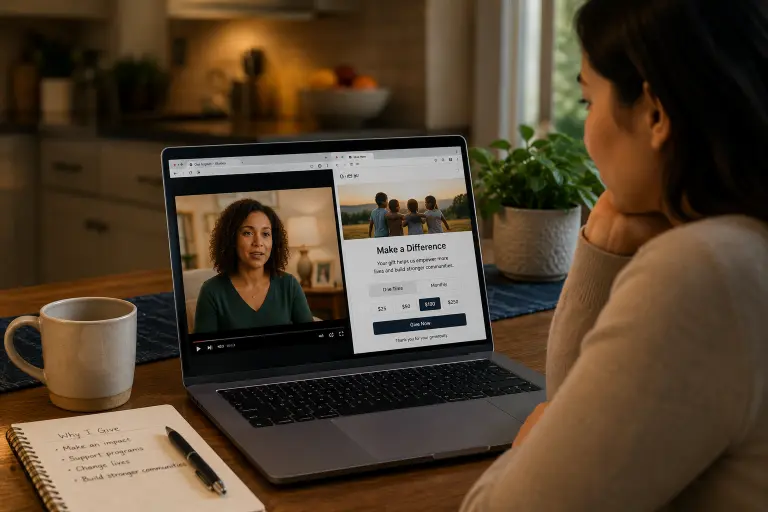
On the donation page, where a hesitating visitor encounters a peer who already resolved the same hesitation.
In major gift solicitation, shown one on one, where a single testimonial from a comparable donor can carry more weight than any deck.
In monthly giving campaigns, where a sustaining donor's explanation of why a recurring gift felt easy removes the primary barrier to sign up.
In legacy giving materials, discussing bequests is awkward for staff and natural for a donor who has made one.
At galas and events, where a donor speaking to a room of peers can precede the ask with more credibility than the executive director, and where organizations running event production and live streaming can extend that peer voice to supporters watching remotely.
In board recruitment, where a candid current member does more to attract quality trustees than any recruitment packet.
They also pair well with the beneficiary stories anchoring your marketing and promotional videos, since desire and permission together convert far better than either alone.
The Practical Ethics of Filming Donors
Donors are not vulnerable in the way beneficiaries often are, but filming them carries its own responsibilities.
Never disclose gift amounts without explicit permission, and think carefully even when permission is granted, because published figures can embarrass smaller donors and invite solicitation from other organizations.
Make declining genuinely easy. A donor asked to appear on camera by an organization they fund is in an awkward position. State clearly and early that saying no changes nothing about the relationship.
Show them the edit before publication. This is unusual in documentary practice and correct here. A donor has an ongoing relationship with your organization, and a surprising edit damages it permanently.
Do not weaponize their network. Featuring a donor and then immediately asking them to solicit their friends converts a testimonial into an obligation, and donors resent it.
Donor Voices in Portland and the Pacific Northwest
Portland's philanthropic community is close knit, regionally loyal, and unusually attentive to how organizations conduct themselves. Donors here talk to one another, which makes peer testimony both more powerful and more consequential to get right.
Portland Production Services has filmed with Pacific Northwest organizations and their supporters for more than 20 years, with fully owned equipment and an in house crew across Portland, Beaverton, Hillsboro, Lake Oswego, Tigard, and Vancouver, WA. For donor interviews specifically, a calm and experienced crew matters enormously, because donors are often less comfortable on camera than they appear, and an unhurried set is what produces candor rather than performance.
Owned gear also means these interviews can be captured efficiently, frequently alongside other production, which keeps the cost of a donor testimonial well within reach of the gifts it will generate.
Let Your Donors Make the Case
Your organization can describe its impact indefinitely and remain, to a prospect, an interested party. A donor with nothing to gain, describing what they checked, what worried them, and why they gave anyway, resolves the doubt your own voice never can.
Beneficiary stories make people want to give. Donor testimonials make them feel safe doing it. You need both, and most nonprofits have only one.
Let's Put Your Donors on Camera
Portland Production Services has helped Pacific Northwest nonprofits capture donor voices for more than 20 years, with owned gear, an in house crew, and the unhurried approach that turns an interview into candor.
Book a consultation with Portland Production Services and tell us who in your donor community others would listen to. We will help them say it well.
Already worked with PPS? Share your experience in a quick review and help the next nonprofit build trust with its community.
Frequently Asked Questions
1.What is a donor testimonial video?
A donor testimonial video features an existing donor explaining why they give to a nonprofit, in their own words, to help prospective donors resolve their own hesitation. It works through peer trust rather than empathy, which is what distinguishes it from a beneficiary story. Its purpose is to make giving feel like a sound decision a reasonable person would make.
2.How are donor testimonials different from beneficiary stories?
Beneficiary stories create desire by generating empathy for someone your work helped, while donor testimonials create permission by showing a peer who investigated the organization and chose to give. Prospects rarely doubt that a cause matters; they doubt whether giving to your organization specifically is wise. Only a fellow donor can settle that credibly.
3.What questions should you ask in a donor testimonial interview?
Ask what almost stopped them from giving, what they checked before they gave, whether they remember the moment they decided, and what they would tell someone considering a first gift. These questions bypass the rehearsed answer donors give at galas and produce the specific reasoning a prospect can actually use. Avoid asking simply why they give.
4.Which donors should a nonprofit feature on camera?
Feature the donor who resembles the prospect you want to reach rather than automatically choosing your largest giver. Monthly giving campaigns need a sustaining donor, major gift solicitation needs someone who describes real due diligence, and legacy giving needs a donor comfortable discussing bequests. A donor community that all looks alike tells prospects a limiting story about who belongs.
Key Takeaways
- Donor testimonials persuade through peer trust, not empathy. Beneficiary stories make prospects want to give, while donor testimonials make them feel safe doing it, and most nonprofits only produce one of the two.
- Match the donor to the ask. A monthly giving prospect does not see themselves in a naming gift donor, and the wrong pairing can actively suppress giving.
- Ask what almost stopped them from giving, what they checked first, and what they would tell a first time donor. These questions get past the rehearsed answer to the reasoning a prospect can use.
- Filming donors carries its own ethics: never publish gift amounts without permission, make declining easy, and show them the edit. PPS brings 20+ years of Pacific Northwest experience and an unhurried crew to interviews that need candor.


Unleash Your Inner Creative Madness With Us!
info@portlandproductionservices.com
503-317-6447
© Portland Production Services 2026
8816 SE 29TH AVE
MILWAUKIE OR 97222-6323, US

