



The Complete Guide to Nonprofit Video Production: How Mission Driven Videos Inspire Donations and Build Trust
**Excerpt:** Learn how nonprofit video production builds donor trust, tells authentic stories, and inspires giving with ethical, mission-driven video strategies.
Nonprofits face a communication problem no business ever does. You are asking people to give money and receive nothing tangible in return. No product ships. No service gets rendered to the donor. What they receive instead is belief: belief that their money did something real, for someone real, somewhere they will likely never visit.
Video is the only medium that closes that gap. It puts the donor in the room, lets them see the person their gift reaches, and makes the mission feel less like an abstraction and more like a responsibility. That is why nonprofit video production built around mission and trust has become the most valuable communication investment a mission driven organization can make. This guide covers what makes it work, what makes it fail, and how to do it right.
Why Video Works Differently for Nonprofits
Commercial video sells a product. The nonprofit video asks for belief. The mechanics of persuasion are fundamentally different, and understanding that difference is the whole game.
A donor's decision is emotional first and rational second. They feel something, then they look for reasons to justify the feeling. Video is the only medium that can deliver emotion and evidence in the same thirty seconds, which is precisely why it outperforms every other format in fundraising.
Video Collapses the Distance Between Donor and Mission
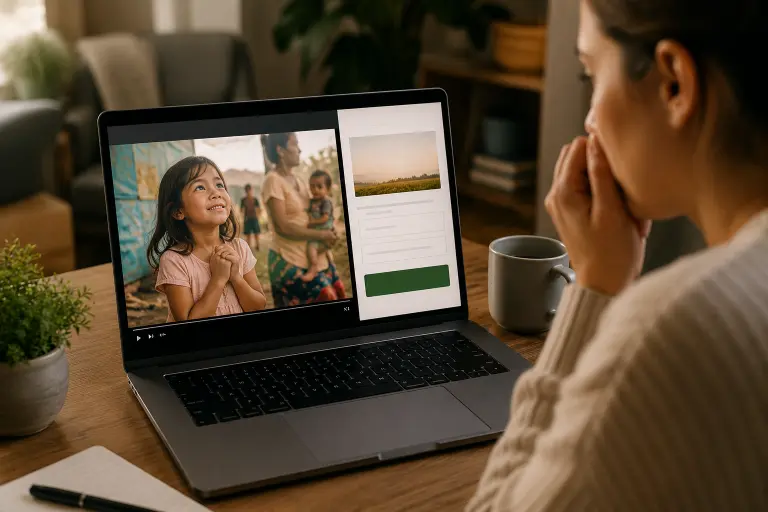
Most donors will never see your work firsthand. They will not visit the shelter, meet the student, or walk the watershed. Video is the closest thing to being there. It replaces the abstraction of a cause with the specificity of a face, a voice, and a place, and specificity is what makes people give.
Video Proves Impact in a Way Reports Cannot
Annual reports tell donors their money worked. Video shows them. A number on a page asks for trust, while a person on screen saying what changed in their life earns it. For organizations competing for limited donor dollars, that proof is the difference between a one time gift and a sustaining relationship.
Video Builds the Trust That Precedes Every Gift
Donors are more skeptical than ever, and rightly so. They want to know their money reaches the mission rather than the overhead. Professional video signals seriousness, transparency, and stewardship before a single word is spoken. An organization that presents itself with care is an organization donors believe handles their money with care.
The Types of Nonprofit Video and What Each Accomplishes
Different moments in a nonprofit's year call for different videos. Matching the type to the goal is the first strategic decision.
The Mission Story Video
This is your anchor asset, the two to three minute film that answers who you serve, what you do, and why it matters. It lives on your homepage, opens your gala, and introduces your organization to every new donor, board member, and partner. Every nonprofit needs one, and most have one that is years out of date.
Impact and Beneficiary Stories
A single well told story of one person's life changed does more fundraising work than any statistic. These videos are the backbone of donor communication, and they are the most reusable asset a nonprofit can own, working across appeals, social, email, and events.
Fundraising Campaign and Appeal Videos
Built for a specific task with a specific deadline, these videos are engineered to convert. They pair emotional urgency with a clear, simple call to action, and they belong at the center of your year-end giving push, your capital campaign, and your giving day.
Event and Gala Videos
The video that plays in the room before the ask is often the single highest leverage minute of your entire fundraising year. It sets the emotional temperature for everything that follows. Organizations running larger galas and conferences often pair this with full event production and live streaming so remote supporters can participate in the moment and give alongside the room.
Volunteer, Donor, and Board Recruitment Videos
Recruitment is a fundraising function in disguise. Video that shows the culture, the people, and the work attracts the volunteers, board members, and major donors who become your organization's long term capacity.
Internal and Training Content
Growing nonprofits carry real training burdens across staff and volunteers. Corporate and training videos produced alongside your fundraising content keep the brand consistent and reduce the overhead cost of repeating the same onboarding in person.
IM
The Ethics of Nonprofit Storytelling
This section matters more than any production technique in this guide, and most nonprofit video advice skips it entirely.
Nonprofit video carries an ethical weight commercial video never does, because the people on screen are often at the most vulnerable moments of their lives. The story belongs to the person telling it, not to the organization filming it. Get this wrong and you produce video that raises money while diminishing the very people you exist to serve.
Dignity Over Pity
The old fundraising playbook relied on despair, showing suffering in its rawest form to trigger guilt. It works in the short term and corrodes everything in the long term. It strips subjects of agency, teaches donors that beneficiaries are helpless, and produces a brand donors eventually tune out.
Dignity driven storytelling shows people as capable, complex, and central to their own progress. The organization is not the hero. The person is. Donors give more, and give longer, to organizations that treat the people they serve with visible respect.
Consent That Is Actually Informed
Signing a release is not the same as understanding one. Meaningful consent means the person knows where the video will appear, how long it will live online, that they may be recognized, and that they can decline or withdraw without any effect on the services they receive. This is a non-negotiable practice, not a legal formality.
Truth Without Manipulation
Do not script emotion into someone's mouth. Do not stage hardship. Do not imply outcomes your programs did not produce. Donors are perceptive, and the moment a story feels manufactured, the trust you were building becomes the trust you destroyed.
What Makes a Nonprofit Video Actually Drive Donations
Emotion opens the door. Craft and structure walk the donor through it.
Lead With One Person, Not the Whole Problem
The scale of a problem paralyzes people. A single person compels them. Open on one face, one name, one situation, and let the broader mission emerge behind it. The instinct to establish the enormity of the issue first is the most common and most costly mistake in nonprofit video.
Show Change, Not Just Need
Donors give to progress, not to despair. A video that establishes a need and stops has asked the viewer to feel bad. A video that shows the need, the intervention, and the change has shown the viewer that giving works. The second one raises money.
Make the Donor the Actor
The most effective nonprofit videos position the donor as the one who makes the change possible. Not a spectator to suffering, but a participant in outcomes. The shift from what we do to what you make possible measurably changes giving behavior.
One Ask, Made Clearly
A video ending with five ways to engage produces no engagement. Name the single action, state the amount if you have one, and make it simple. Vagueness at the moment of highest emotion is where most nonprofit videos lose the gift they had already earned.
Audio Carries the Emotion
Nonprofit video lives or dies on the voice. A story told in a person's own words, captured cleanly, is the most persuasive asset in fundraising. Poor audio does not just sound bad. It makes an authentic story feel amateur, which quietly undermines the credibility of everything the organization says next.
Nonprofit Video Production in Portland and the Pacific Northwest
Portland has an unusually dense nonprofit sector, from housing and food security organizations to environmental groups, arts institutions, and health equity initiatives. Working with a production partner who already understands that landscape shortens the distance between idea and finished film.
Portland Production Services has produced video for Pacific Northwest organizations for more than 20 years, with fully owned equipment and an in house crew. For nonprofits specifically, owned gear matters more than most clients realize, because it means no rental markups on an invoice that came from donor dollars, and no scheduling delays when a program moment cannot be rescheduled.
The team works across Portland, Beaverton, Hillsboro, Lake Oswego, Tigard, and Vancouver, WA, with production capabilities throughout the broader Pacific Northwest. That local presence means no travel days on the budget, familiarity with the venues and communities you serve, and the ability to move quickly when a story presents itself on short notice.
Nonprofits also frequently need production that crosses categories. The same organizations that need mission films often need marketing and promotional videos for awareness campaigns, and both are stronger when a single team builds them with one consistent visual identity.
Making a Nonprofit Budget Go Further
Every dollar spent on production is a dollar not spent on the mission, and that tension is real. The answer is not to spend less. It is to extract more from what you spend.
Batch your production. A single well planned shoot day can capture your mission film, two beneficiary stories, b-roll for the year, and social cuts. Nonprofits that shoot once and publish for twelve months get a dramatically lower cost per asset than those commissioning videos one at a time.
Use real voices instead of paid talent. The people you serve, your staff, and your volunteers are more credible than any actor, and they cost nothing. Authenticity is both the cheaper and the better choice.
Plan the repurposing before the shoot. Decide in advance which cuts you need for the gala, the year end appeal, social, and the website, so one production feeds every channel rather than requiring new shoots.
Spend where donors notice. Clean audio, steady framing, and a well paced edit build trust. Exotic camera equipment does not. Put the budget into what the viewer actually perceives.
Match the tier to the stakes. Your mission film and your gala video justify professional production. A quick volunteer thank you does not. Deploy the budget where the video carries real fundraising weight.
Video Is How a Mission Becomes Believable
A nonprofit's hardest job is making a distant reality feel immediate and a stranger's need feel personal. No brochure does that. No spreadsheet does that. Video does it in ninety seconds, and it does it in a way that outlasts the campaign it was made for.
The organizations that fundraise well are not the ones with the most compelling missions. Every mission is compelling to the people inside it. They are the ones who learned to make the outside feel what the inside already knows.
Let's Tell Your Mission's Story
Portland Production Services has helped Pacific Northwest nonprofits turn their missions into films that move donors for more than 20 years, with owned gear, an in house crew, and a deep respect for the people whose stories we film.
Book a consultation with Portland Production Services and bring us your mission, your audience, and your goal. We will build the video that makes people believe in it.
Already worked with PPS? Share your experience in a quick review and help the next Portland nonprofit find a production partner who understands the work.
Frequently Asked Questions
1. What is nonprofit video production?
Nonprofit video production is the creation of mission driven video content designed to build donor trust, communicate impact, and inspire giving. It spans mission films, beneficiary stories, fundraising appeals, gala videos, and recruitment content. Unlike commercial video, it centers ethical storytelling and the dignity of the people an organization serves.
2. How does video increase nonprofit donations?
Video increases donations by collapsing the distance between the donor and the mission, showing real people and real change instead of abstract statistics. It delivers emotion and evidence together, which is how giving decisions are actually made. Videos that feature one person's story, show measurable change, and end with a single clear ask consistently outperform text based appeals.
3. What makes an effective nonprofit fundraising video?
An effective nonprofit fundraising video leads with one person rather than the whole problem, shows change instead of only need, positions the donor as the one making that change possible, and closes with a single clear ask. Clean audio matters more than expensive cameras, because the subject's own voice carries the emotional weight. Dignity driven storytelling outperforms pity based appeals over time.
4. How can a nonprofit afford professional video production?
The most effective approach is batching, capturing a mission film, beneficiary stories, and a year of b-roll and social cuts in one planned shoot day, which sharply lowers the cost per finished video. Using real staff, volunteers, and program participants instead of paid talent also reduces cost while increasing authenticity. Reserve professional production for the videos carrying real fundraising weight.
Key Takeaways
- Nonprofit video works differently than commercial video because it asks for belief rather than selling a product, delivering emotion and evidence together in a way no report or appeal letter can.
- Ethical storytelling is the foundation, not an afterthought. Dignity over pity, genuinely informed consent, and truth without manipulation protect both the people you serve and the donor trust you depend on.
- The videos that raise money follow a structure: lead with one person, show change rather than only need, make the donor the actor, close with a single clear ask, and never compromise on audio.
- Stretch the budget by batching production, using real voices instead of paid talent, and planning repurposing before the shoot. PPS brings 20+ years of Pacific Northwest experience, owned gear, and an in house crew so donor dollars go further.
There's more ...


Unleash Your Inner Creative Madness With Us!
info@portlandproductionservices.com
503-317-6447
© Portland Production Services 2026
8816 SE 29TH AVE
MILWAUKIE OR 97222-6323, US

