


Why Your Brand Needs a Commercial Video Production Company
Hiring a commercial video production company gives your business the strategy, expertise, and professional execution needed to create videos that build trust, drive conversions, and deliver measurable marketing results.
Your competitors are publishing video right now. Some of it is good. Most of it is forgettable. The brands pulling ahead are not the ones posting the most video, they are the ones whose video was built by people who understand what makes a viewer act.
That is the case for hiring a commercial video production company that builds video around business outcomes instead of gambling your brand on DIY footage or a rotating cast of freelancers. This article lays out exactly what a real production company changes for your brand, when the investment makes sense, and how to tell a legitimate operation from a guy with a camera and a logo.
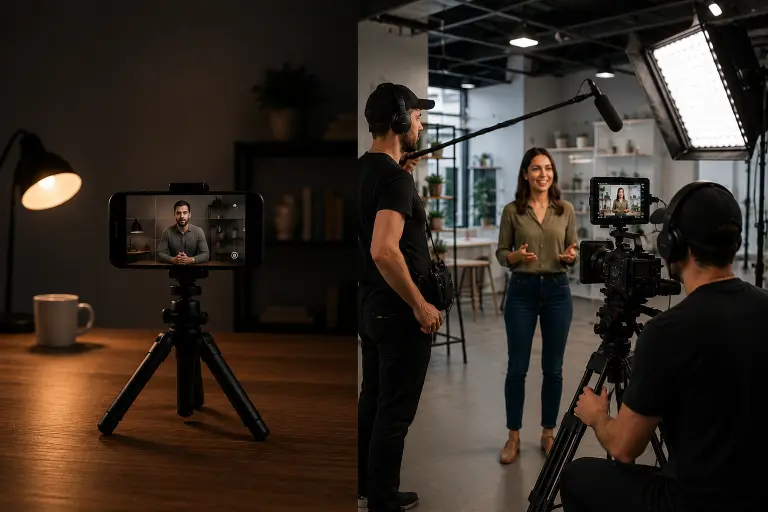
The Real Cost of DIY Video and Freelancer Roulette
Every brand that delays hiring a commercial video production company is already paying for video. The cost just shows up in places that never appear on an invoice.
DIY video costs you in credibility. Buyers form quality judgments in seconds. Shaky framing, muddy audio, and flat lighting tell a prospect your brand cuts corners before they have heard a word of your pitch. The damage is silent because the prospects who bounce never tell you why.
Freelancer roulette costs you in consistency. One freelancer shoots your brand video, a different one cuts your product demo, a third handles the testimonial. Three projects, three visual styles, three interpretations of your brand. Now your video library looks like it belongs to three different companies.
Internal production costs you an opportunity. Every hour your marketing team spends learning color correction is an hour not spent on the strategy work they were hired to do. The footage usually ends up unusable anyway, which means paying twice: once in salary, once for the reshoot.
The Hidden Reshoot Tax
Ask any brand that went cheap on video what the project actually cost and the honest answer includes the second attempt. Reshoots happen when planning fails: missing shots discovered in the edit, audio that cannot be salvaged, a location that fell through mid-day. A professional production company prevents these failures before the shoot day because preventing them is the core of the job.
What a Commercial Video Production Company Actually Brings to the Table
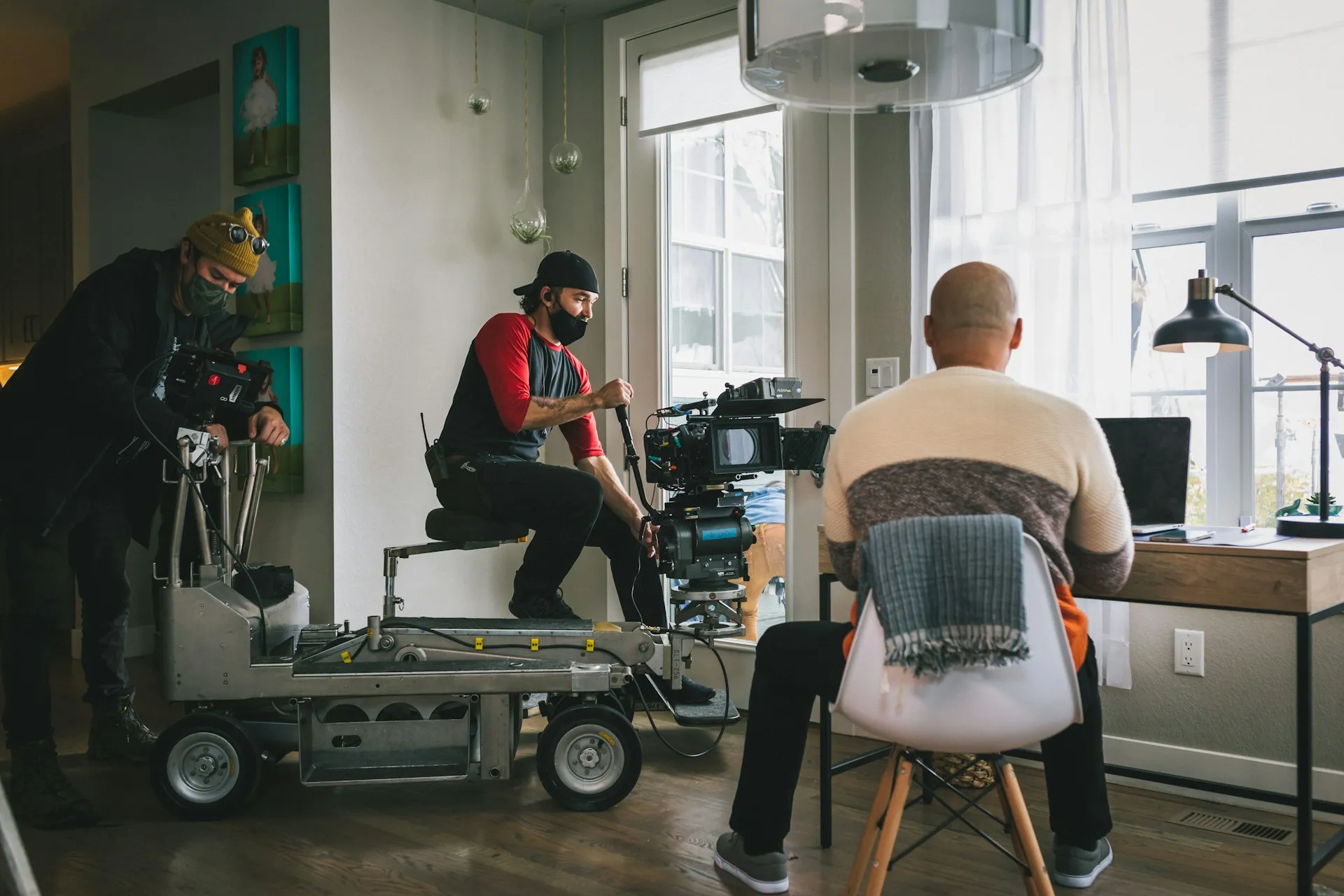
A commercial video production company is not a camera rental with people attached. The value sits in five capabilities that DIY setups and solo operators structurally cannot match.
A Strategy Layer Before Anything Gets Filmed
Professional production starts with questions, not equipment: who needs to see this, what do they need to believe, and what should they do next. The answers shape the script, the shot list, the locations, and the edit. Footage without that layer is decoration. Footage with it is a sales asset.
A Complete Crew Under One Roof
Director, camera operator, lighting, audio, editing, color, and motion graphics, coordinated as one team that has worked together before. There are no handoff gaps, no version conflicts, and no finger pointing when something needs fixing. One contract, one point of contact, one accountable team.
Owned Equipment That Never Bottlenecks a Project
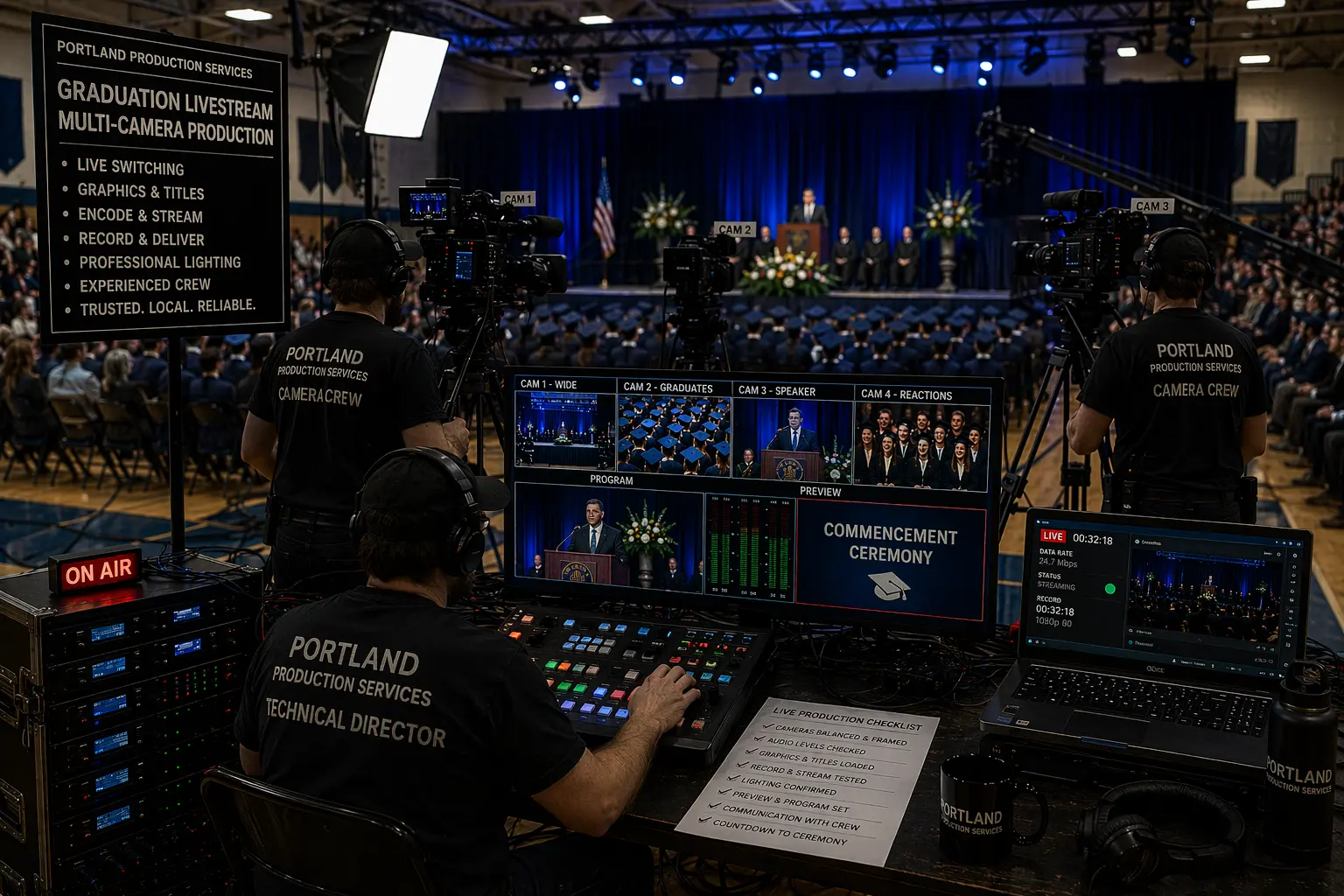
Portland Production Services owns its cameras, lenses, lighting, audio, switching, and streaming gear outright. Owned gear means no rental markups on your invoice, no scheduling delays waiting on a rental house, and equipment maintained by the people whose reputation depends on it working. When a shoot day changes at the last minute, an owned-gear company adapts the same afternoon.
Production Insurance, Permits, and Logistics Handled
Commercial shoots involve liability coverage, location permits, talent releases, and music licensing. Get any of these wrong and a finished video becomes a legal problem. An established production company carries the insurance, knows the permit offices, and handles the paperwork as a routine part of the engagement.
Post-Production Depth That Protects the Investment
The edit is where commercials are won. Professional post-production includes color grading calibrated to your brand, mixed and mastered audio, licensed music, motion graphics, and delivery files formatted correctly for every platform you publish on. This is the difference between a video that competes on broadcast and one that only survives on a phone screen.
Five Signs Your Brand Has Outgrown In-House Video
Not every brand needs a production company on day one. These are the signals that the moment has arrived.
Your video views are fine but your conversions are flat. Watchable video and converting video are different products. If people watch and do not act, the problem is strategy and craft, not distribution.
You are entering a market where trust decides the sale. Healthcare, construction, financial services, real estate, and B2B manufacturing buyers all evaluate production quality as a proxy for company quality. PPS has built video for exactly these audiences across manufacturing and healthcare clients where polish is not vanity, it is a ranking factor in the buyer's head.
Your sales team keeps answering the same questions. Recurring objections and repeated explanations are a script waiting to be produced. One well-built video answers the question a thousand times without burning a single sales hour.
You have an event coming and no capture plan. Conferences, launches, and trade shows generate once-a-year content. A production company that also runs full-scale event production turns the event itself into a year of marketing footage instead of a missed opportunity.
Your brand looks different in every video you have published. Inconsistency is the tell of fragmented production. A single production partner locks your visual identity across every asset.
How a Production Company Protects Your Budget, Timeline, and Brand
The objection to hiring a commercial video production company is always cost. The reality is that a professional company is a cost control mechanism, not a cost center.
Fixed Scope Kills Budget Creep
A legitimate production company quotes against a defined scope built in pre-production: deliverables, shoot days, revision rounds, and delivery dates in writing. DIY and freelancer projects drift because nobody defined done. Scoped projects end.
One Shoot, a Library of Assets
Production companies plan shoots to maximize coverage. A single well-planned production day yields the hero commercial plus social cuts, vertical versions, testimonial pulls, and b-roll that feeds your content calendar for months. The cost per usable asset drops every time the footage gets repurposed.
Two Decades of Portland Logistics in Your Corner
Portland Production Services has produced commercial work in this market for more than 20 years. That means knowing which Portland locations photograph well at which time of day, how long permits actually take, where to park a grip truck downtown, and which Pacific Northwest weather windows to trust. Crews working unfamiliar territory burn budget discovering what an established local company already knows.
That local depth covers the entire metro: Portland, Beaverton, Hillsboro, Lake Oswego, Tigard, and Vancouver, WA, plus production travel throughout the Pacific Northwest when the project calls for it.
Proof Over Promises
Any company can claim results. The Westland Investors project shows how PPS built investor-facing video for a firm where credibility was the entire assignment, and the Oswego Hills Vineyard and Winery work shows the same team translating a Pacific Northwest brand identity into commercial storytelling. Ask any production company you evaluate for equivalent receipts.
Questions to Ask Before You Hire a Commercial Video Production Company
Use these in your first conversation. The answers separate professionals from pretenders fast.
Do you own your equipment or rent per project? Renting is not disqualifying, but owned gear signals stability, faster scheduling, and cleaner pricing.
Walk me through your pre-production process. If the answer jumps straight to shoot day, the strategy layer does not exist. Keep looking.
Who exactly will be on my crew? Some companies sell with a senior team and staff the job with whoever is available. Get names.
What happens when scope changes mid-project? Professionals have a written change process. Amateurs have surprises on the final invoice.
Can you handle distribution formats beyond the main cut? Your video needs to work on broadcast, web, paid social, and vertical mobile. Confirm deliverables for every channel before signing, including whether the company can support live streaming if your content strategy includes live broadcast.
Stop Settling for Video That Just Exists
Video that exists fills a content calendar. Video built by a commercial video production company fills a pipeline. The difference is strategy, craft, owned equipment, and a team accountable for the outcome, not just the footage.
Your brand is already being judged on video quality whether you have invested in it or not. The only question is whether that judgment is working for you or against you.
Get a Production Partner That Treats Your Budget Like Its Own
Portland Production Services has spent over 20 years producing commercial video for Pacific Northwest brands with in-house gear, in-house crew, and a process that delivers on scope and on schedule.
Contact Portland Production Services for a commercial video consultation and bring your toughest business problem. We will tell you whether video solves it and exactly how we would build it.
Worked with PPS before? Take two minutes to leave a review about your experience. It helps Portland brands find production they can actually trust.
Frequently Asked Questions
What does a commercial video production company do?
A commercial video production company manages the complete process of creating professional video for business goals: strategy, scripting, filming, editing, color, audio, and final delivery for every platform. The company supplies the crew, equipment, insurance, and project management so the client's only job is approving the work. The end product is video engineered to drive a specific action, such as a sale, a lead, or a donation.
Is hiring a commercial video production company worth it for a small business?
Yes, when the video has a revenue job to do. A small business with one professionally produced commercial that converts will outperform a competitor publishing weekly DIY content that does not. Production companies also plan shoots so a single day of filming generates months of usable content, which brings the cost per asset down to a level most small businesses find very workable.
What is the difference between a production company and a freelancer?
A freelancer is one person covering camera, audio, lighting, editing, and project management alone, which forces compromises in at least one of those areas. A production company fields specialists for each role, carries production insurance, owns professional equipment, and remains accountable as a business entity. For commercial work where the video represents your brand publicly, that structural depth is the safer investment.
How do I prepare for working with a video production company?
Come with clarity on three things: who the video is for, what business result it needs to produce, and where it will be published. You do not need a script, a creative concept, or technical knowledge, because developing those is the production company's job during pre-production. The clearer your business goal, the sharper the final video.
Key Takeaways
- A commercial video production company is a conversion investment, not a content expense. Strategy, professional crew, and post-production depth turn video from decoration into a sales asset with a measurable job.
- DIY video and freelance patchwork carry hidden costs in credibility, brand inconsistency, reshoots, and burned internal hours that never show up on an invoice but always show up in results.
- Owned equipment and local logistics knowledge protect budgets and timelines. PPS runs its own gear and brings 20+ years of Portland and Pacific Northwest production experience to every shoot.
- Vet any production company on process, crew, and proof. Ask about pre-production, equipment ownership, named crew members, and documented client results before signing anything.
There's more ...

.webp)
Unleash Your Inner Creative Madness With Us!
info@portlandproductionservices.com
503-317-6447
© Portland Production Services 2026
8816 SE 29TH AVE
MILWAUKIE OR 97222-6323, US

