


What Are The Best Microphones For Live Streaming
There are a lot of factors that go into making a successful live stream, but perhaps none are more important than good audio quality.
Good audio quality is the single most important factor in a successful live stream. This guide covers five professional-grade microphones, the Shure Beta 58a, Rode Pro Podcaster, Rode M5, Shure 412 Gooseneck, and Rode Shotgun, and explains exactly when and why to use each one.
Why Audio Quality Defines Your Live Stream
There are a lot of factors that go into making a successful live stream, but perhaps none are more important than good audio quality. For many of the live streaming events we handle, we might need to use several different types of microphones for a variety of scenarios. We will always bring multiple microphones to make sure that we have the best audio possible.
If you are holding a live streaming event, while the camera and broadcaster are both important, the age of the iPhone means that pretty much everyone has a powerful camera in their pocket. Social media sites such as YouTube and Facebook make it easy to go live with the push of a button. But while the video and broadcasting elements may seem straightforward, recording professional-level audio is a different story entirely. That's where it becomes necessary to use additional gear to ensure that everyone listening at home can hear what is being said crisply and cleanly.
With that in mind, let's take a look at the different types of microphones we use on a regular basis and what each one is built for. For a full overview of our professional streaming setup, see our guide on livestreaming your event.
1. Shure Beta 58a
The Shure Beta 58a is known as a very reliable and versatile microphone that can be used for a lot of different scenarios. It is what's known as a dynamic mic, which is a kind of microphone that takes sound waves and converts them into an electrical signal via electromagnetism. There are two main types of dynamic microphones: those that use a moving coil and those based on ribbon microphones.
The Shure Beta 58a uses a moving coil magnetic diaphragm, which makes it possible to reliably capture sound. It is especially useful at high sound pressure levels, meaning you can use it at loud events such as concerts or sporting events. It is also designed for quieter settings, which is a major reason it is considered so versatile.
These microphones look like a traditional handheld microphone, the kind you hold close to your mouth while speaking. At a wedding, they are perfect for giving toasts and speeches, or for the MC to use while making announcements. They can also be placed on a mic stand to capture the sound from a live musical performance at a wedding or funeral. At their price point, they are among the best dynamic mics on the market.
2. Rode Pro Podcaster
Rode is one of the leading companies when it comes to producing high-end mics. At a more affordable price point, the Rode Pro Podcaster was specifically designed to get professional-level audio for home podcasters who may not be able to afford to record in a professional studio. At Portland Production Services, however, we've found a number of great uses for this simple but versatile mic.
One of the most common types of events we need to live stream are panel discussions at conferences, seminars, and presentations. You'll have four or five people at a table speaking to the audience, and might have a separate moderator positioned somewhere else on stage. We try to avoid the situation where one or two mics on stage are being passed back and forth between speakers, as this tends to bog down the discussion and make it less organic. This is why the Rode Pro Podcaster is such a terrific solution.
We can set up a mic in front of each speaker so they are all talking directly into a microphone at all times. For the moderator, we either provide a Podcaster mic as well, or if they need the freedom to move around on stage, we'll give them a handheld mic like the Shure Beta described above. We'd then have one or two wireless microphones on hand for audience questions. This is a great example of how a single event production scenario might need different types of microphones for everyone involved.
3. Rode M5
The Rode M5 is what is known as a pencil-thin condenser microphone. They do not have the ball head we normally associate with handheld microphones. What's great about these little microphones is that they are cardioid microphones, meaning they only pick up sound from the front. Audio coming from the side or rear is generally blocked out. This is why they are so popular for recording bands and concerts.
These are excellent microphones to use in noisy environments where you only want to pick up a single speaker. While a bit more expensive than some entry or mid-level options, the excellent sound fidelity they provide more than makes up for the added cost. The only drawback for events is that they cannot easily be used as handheld microphones and require a stand setup.
According to the Audio Engineering Society, cardioid microphone patterns are the most widely used for live event applications precisely because of their front-focus and ambient-noise rejection properties.
4. Shure 412 Gooseneck
These mics are known as gooseneck microphones because they have a long, thin, flexible stand that allows the user to finely adjust the positioning. They are similar to cardioid mics but have an even narrower area of sensitivity. This means that the speaker is better isolated and ambient sound is blocked out. They also offer greater feedback resistance, which can be an annoying problem at events when low-quality mics or amplifiers are used.
You'll most likely see these mics on podiums or lecterns. They make a great option for keynote speakers or moderators. In the panel scenario described above, your panel might be using individual Podcaster mics while the MC is at a separate podium with the Shure 412 Gooseneck. As always, it's imperative to approach events with an eye on versatility and adaptability, so you can adjust to the circumstances as needed.
5. Rode Shotgun Mic
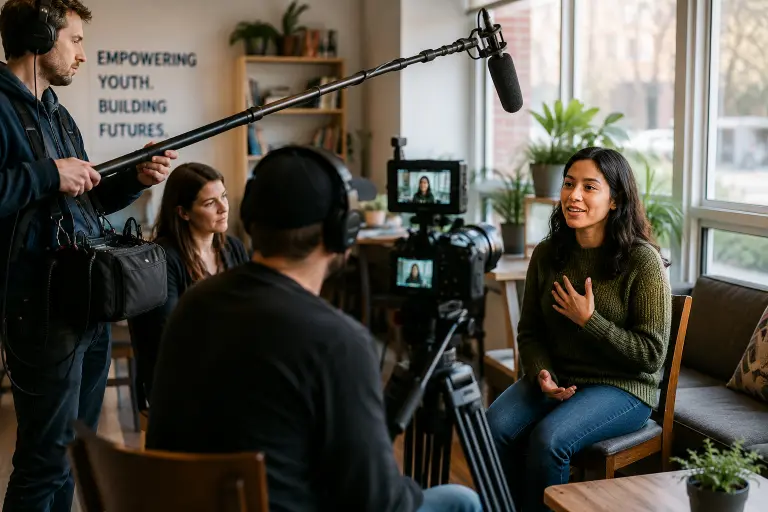
In the audio world, shotgun mics, also called line or gradient microphones, are a standard must-have for live events. These are the long microphones you'll see sound people holding at the end of a pole positioned overhead. Rode's shotgun mic lineup offers options at various price points, depending on your budget.
These mics are known as hyper cardioids, with a very narrow range that is able to pick up sounds at a greater distance than a standard dynamic mic. The capsule is located at one end of an interference tube, helping to eliminate sounds from the rear or sides through phase cancellation.
These mics are used when the speaker is some distance away from the microphone. If it's not possible to provide individual mics for each speaker, or even a handheld mic passed back and forth, then your only option may be to place a shotgun mic next to your camera or sound recorder and aim it at the speaker from a distance. Just keep in mind that you're likely to pick up more ambient noise, and you will need to move the mic to follow the speaker if they are moving around.
For guidance on how all of these microphone types come together in a complete audio setup, see our overview of Godox lights and event gear, which covers how lighting and audio equipment interact in a professional live production setup.
Get Professional Audio for Your Next Live Stream or Event
There is no single best microphone for every live streaming scenario. The right mic depends on the event type, the number of speakers, the venue acoustics, and the distance between the speaker and the microphone. That's why experienced live streaming professionals always arrive with a variety of microphone options ready to deploy.
A panel discussion, a wedding ceremony, a keynote presentation, and an outdoor corporate event each demand a different combination of mics, stands, and audio board settings. Getting it right requires both the right equipment and the hands-on experience to know when and how to use each piece.
Portland Production Services brings a full professional microphone kit to every live streaming event. If you want your next event to sound as good as it looks, get in touch today and let's plan your setup together.
Need professional-grade audio for your next live stream or event? Talk to our production team!
There's more ...
.webp)

Unleash Your Inner Creative Madness With Us!
info@portlandproductionservices.com
503-317-6447
© Portland Production Services 2026
8816 SE 29TH AVE
MILWAUKIE OR 97222-6323, US

